Earnings estimates for Verizon Communications Inc. VZ for fiscal 2026 and fiscal 2027 have moved up 1.21% to $5.03 and 0.38% to $5.29, respectively, over the past 60 days. The positive estimate revision depicts bullish sentiments about the stock’s growth potential.
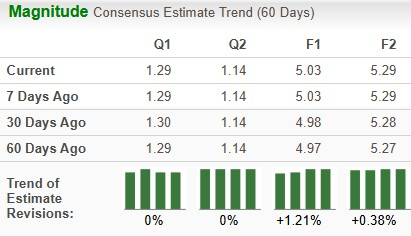
Image Source: Zacks Investment Research
Verizon’s Wireless and Broadband Growth Gains Momentum
Verizon’s wireless business is showing solid subscriber momentum. During the second quarter, the company posted 184,000 postpaid phone net additions during the quarter, marking its strongest consumer second-quarter performance in five years. Core prepaid net additions totaled 73,000, extending the company's streak of positive prepaid subscriber growth to eight consecutive quarters.
Consumer postpaid phone churn declined to 84 basis points from 95 basis points in the fourth quarter of 2025. Verizon disclosed that promotional customer acquisition costs declined about 15% year over year and retention costs fell about 17%. Hence, the important driver is not only higher gross adds but also lower churn. This shows improving customer economics and greater operating leverage for Verizon.
Verizon has taken several approaches to further boost customer economics. In the second quarter, the company launched its Simplicity wireless plan, Verizon One and a companywide loyalty program. These offerings are designed to reduce churn and increase customer lifetime value. Verizon is increasingly using its wireless and broadband assets together. The Verizon One offering combines mobility and broadband into a single offering. The bundled offering also simplifies the customer experience. By opting for a single service provider for all internet requirements, users can bypass the billing, service and customer support-related complexities from several vendors. For Verizon, it increases customer stickiness, bringing significant cross-selling opportunities.
AI Infrastructure Investment is Becoming a New Growth Vector
Google has signed an agreement worth more than $1 billion to use Verizon’s dark-fiber routes to connect its data centers. Verizon boasts an extensive metro fiber network that can offer low-latency and resilient connectivity needed to link data centers. Verizon is also converting some of its existing central offices into edge data centers to support AI inference closer to end users. The company is reportedly exploring deals with other hyperscalers as well. These AI infrastructure-related initiatives can become a major revenue-generating source for the next several years.
Major Challenges for Verizon
Fixed wireless access (FWA) remains an important growth engine for the company. However, FWA net additions fell 30.6% year over year to 193,000 in the second quarter. Clearly, growth momentum has weakened to some extent.
At the end of the second quarter of 2026, total unsecured debt stood at $136.5 billion, while net unsecured debt totaled $128.7 billion. Although both balances improved from the first quarter through stronger cash generation and debt reduction, net unsecured debt to adjusted EBITDA remained 2.5x. As of 2026, Verizon’s current ratio stood at 0.60, while its quick ratio was 0.57. A current ratio of lower than 1 suggests that the company might face difficulties in paying off short-term obligations.
Verizon continues to operate in a mature U.S. wireless market where national carriers and cable competitors compete aggressively on pricing, promotions and bundled offerings. The company faces competition from other major players, such as AT&T, Inc. T and T-Mobile, US, Inc. TMUS. AT&T is rapidly expanding its fiber infrastructure and has also undertaken a convergence strategy to drive user growth.
Price Performance
Verizon has gained 8.2% in the past year compared with the Wireless National industry’s growth of 79%. The stock has underperformed the Zacks Computer & Technology sector during this time period.

Image Source: Zacks Investment Research
The company has outperformed its peers like AT&T and T-Mobile. Shares of AT&T have declined 13.7%, while T-Mobile has declined 28.8% during this period.
Key Valuation Metric of VZ
From a valuation standpoint, VZ appears to be trading relatively cheaper compared to the industry but trading above its mean. Going by the price/earnings ratio, the company’s shares currently trade at 9.11, lower than 38.13 for the industry.

Image Source: Zacks Investment Research
End Note
Verizon continues to strengthen its long-term investment case through improving customer acquisition, lower churn, broadband expansion and disciplined execution. Upward estimate revision underscores growing investor confidence. Verizon's new Simplicity plans, Verizon One offering and loyalty program are designed to improve customer retention without materially increasing promotional spending, but sustained competitive responses from rivals could slow margin expansion and reduce the benefits of improving customer economics over time. High debt burden remains a major concern. With a Zacks Rank #3 (Hold), VZ appears to be treading in the middle of the road, and new investors could be better off if they trade with caution. You can see the complete list of today’s Zacks #1 Rank (Strong Buy) stocks here.
Beyond Nvidia: AI's Second Wave Is Here
The AI revolution has already minted millionaires. But the stocks everyone knows about aren't likely to keep delivering the biggest profits. AI’s second wave is moving from infrastructure to implementation and these companies are at the forefront of this transition, positioned to become what Amazon and Google were to the internet era.
See Stocks Now >>Want the latest recommendations from Zacks Investment Research? Today, you can download 7 Best Stocks for the Next 30 Days. Click to get this free report
Verizon Communications Inc. (VZ): Free Stock Analysis Report
AT&T Inc. (T): Free Stock Analysis Report
T-Mobile US, Inc. (TMUS): Free Stock Analysis ReportThis article originally published on Zacks Investment Research (zacks.com).
Zacks Investment Research