Lockheed Martin LMT and Northrop Grumman NOC are both large U.S. aerospace and defense contractors that rely heavily on government and military spending. They design and build sophisticated defense platforms, weapons, aircraft, space systems, sensors, and other technologies for the U.S. government and allied countries. Because both companies participate in large, long-duration defense programs, their financial performance is influenced by similar factors, such as U.S. defense budgets, geopolitical tensions, military modernization and demand for advanced weapons systems.
The two companies are industry peers, although their businesses are not identical. Lockheed Martin is particularly strong in areas such as the F-35 fighter jet, missile defense, tactical missiles and other major weapons platforms. Northrop Grumman has a particularly strong position in strategic aircraft, space systems, missile defense, advanced sensors and the B-21 Raider program. In other words, both companies benefit from the same broad defense spending cycle, but they have different programs and technologies driving their growth.
Let's compare the two stocks' fundamentals to determine which one is better positioned at present.
The Standpoint of LMT
Lockheed is converting elevated demand into longer-duration awards that improve revenue visibility and support capacity planning. Backlog reached a record $230 billion as of June 28, 2026, after the company booked $65 billion of second-quarter orders and achieved a 3.2 book-to-bill ratio. The total includes a seven-year, $35 billion contract to quadruple THAAD interceptor production, alongside new GMLRS, HIMARS, radar and space awards. The F-35 remains a central franchise program for Lockheed’s Aeronautics segment, combining production, upgrades and long-duration sustainment work. Second-quarter 2026 F-35 sales increased $475 million due to higher production volume, helping Aeronautics sales rise 9% to $8.11 billion.
International customers represented 28% of Lockheed’s 2025 sales, providing a broad demand base beyond U.S. programs. The company is extending that presence through co-production and regional sustainment initiatives. It signed an agreement with Rheinmetall to pursue ATACMS production in Europe and is supporting exploration of a dedicated European PAC-3 maintenance facility.
The Standpoint of NOC
Northrop Grumman retains a broad position across strategic deterrence, space, missile defense, advanced aircraft and mission systems. Second-quarter 2026 net awards reached $20 billion, producing a 1.84 book-to-bill ratio and lifting backlog 17% year over year to a record $104.7 billion. The company expects to recognize about 35% of this backlog over the next 12 months and 55% over the next 24 months.
Foreign demand is becoming a larger contributor as allies increase spending on air and missile defense, surveillance and advanced weapons. International sales reached $1.54 billion in the second quarter of 2026, or 14% of total sales, compared with $1.40 billion and 13% a year earlier. Management continues to target $10 billion of annual international sales by 2031, roughly double its prior level.
How Do Zacks Estimates Compare for LMT & NOC?
The Zacks Consensus Estimate for Lockheed Martin’s 2026 and 2027 earnings per share (EPS) indicates an increase of 31.44% and 8.4%, respectively. LMT’s long-term (three to five years) earnings growth rate is 19.19%.
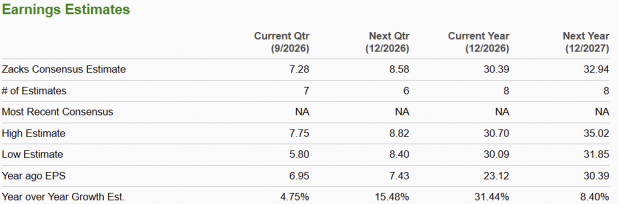
Image Source: Zacks Investment Research
The Zacks Consensus Estimate for Northrop Grumman’s 2026 and 2027 EPS indicates an increase of 9.45% and 5.57%, respectively. NOC’s long-term earnings growth rate is 5.33%.
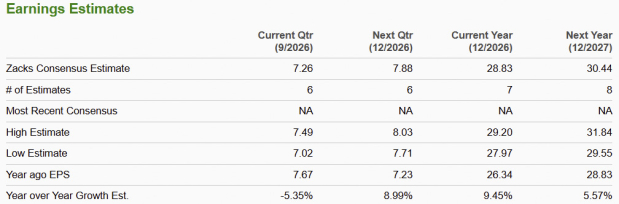
Image Source: Zacks Investment Research
Valuation for LMT & NOC
LMT shares trade at a forward 12-month Price/Sales (P/S F12M) of 1.57X compared with NOC’s P/S F12M of 1.71X.
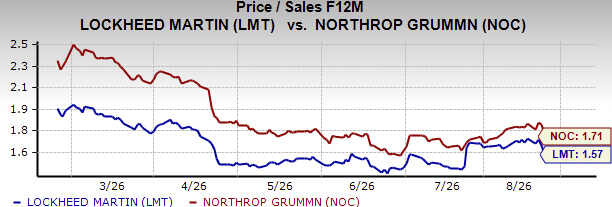
Image Source: Zacks Investment Research
Liquidity of LMT & NOC
Lockheed Martin and Northrop Grumman’s current ratio is 1.19 and 1.17, respectively. A current ratio greater than one indicates that the company has enough short-term assets to liquidate to cover all short-term liabilities, if necessary.
LMT & NOC’s Price Performance
In the past three months, shares of Lockheed Martin have increased 5.7%, while those of Northrop Grumman have declined 0.8%.

Image Source: Zacks Investment Research
LMT or NOC: Which Is a Better Choice Now?
Lockheed Martin is converting strong defense demand into long-term contracts, improving revenue visibility and supporting growth across missiles, space systems, radar and the F-35 program. LMT’s growing international presence and European partnerships further diversify demand and create additional long-term growth opportunities. Northrop Grumman has strong positions across defense, space, missile defense and advanced aircraft, supported by a growing backlog and solid new orders.
Our choice at the moment is Lockheed Martin, given its better price performance, strong earnings growth, solid liquidity and better valuation than NOC. Both LMT and NOC carry a Zacks Rank #3 (Hold) at present. You can see the complete list of today’s Zacks #1 Rank (Strong Buy) stocks here.
Beyond Nvidia: AI's Second Wave Is Here
The AI revolution has already minted millionaires. But the stocks everyone knows about aren't likely to keep delivering the biggest profits. AI’s second wave is moving from infrastructure to implementation and these companies are at the forefront of this transition, positioned to become what Amazon and Google were to the internet era.
See Stocks Now >>Want the latest recommendations from Zacks Investment Research? Today, you can download 7 Best Stocks for the Next 30 Days. Click to get this free report
Lockheed Martin Corporation (LMT): Free Stock Analysis Report
Northrop Grumman Corporation (NOC): Free Stock Analysis ReportThis article originally published on Zacks Investment Research (zacks.com).
Zacks Investment Research