Wells Fargo & Company WFC and The PNC Financial Services Group, Inc. PNC are two prominent U.S. banking institutions offering a broad range of financial services to consumers, businesses and institutional clients. Both banks benefit from diversified business models spanning retail and commercial banking, lending, wealth management and capital markets-related services. However, differences in their scale, geographic footprint, business mix and growth strategies could influence their financial performance and long-term prospects.
Against this backdrop, investors naturally ask: Which bank, WFC or PNC, is better positioned for growth and offers greater upside potential? Let us take a closer look at their fundamentals to find out.
The Case for WFC
Wells Fargo has been expanding across multiple business lines since the Fed lifted the asset cap that had limited its growth since 2018. With this, the company can boost deposits, grow its loan portfolio and broaden its securities holdings, supporting NII growth in the future. Management expects NII to be $50 billion in 2026, up from $47.5 billion in 2025, driven by balance-sheet growth, a favorable loan and deposit mix, and continued fixed-asset repricing.
Wells Fargo’s multi-year simplification strategy is another key growth driver. Under CEO Charlie Scharf, who has led the bank since 2019, the bank has been exiting non-core and lower-return businesses to focus resources on higher-return areas. As part of this effort, WFC sold its rail lease portfolio to a joint venture between GATX Corporation and Brookfield Infrastructure Partners in January 2026. These divestitures are helping streamline operations and improve capital efficiency, while allowing WFC to concentrate on its core businesses.
The company has been taking a strategic approach to its branch network and total headcount, reducing branch count 1.3% year over year to 4,079 and headcount 7.2% to nearly 197,500. Although non-interest expenses increased 2.6% year over year in the first half, continued branch optimization, workforce reductions and technology investments are expected to generate furtherefficiencies. Together, these initiatives are supporting profitability, with return on tangible common equity (ROTCE) reaching 17.7% in the second quarter of 2026, within management’s sustainable medium-term target of 17%-18%.
The Case for PNC
Similar to WFC, PNC Financialis also benefiting from favorable NII trends, supported by solid commercial loan growth and a favorable deposit mix. The bank’s NII increased 14.7% year over year in the first half of 2026, as these factors helped to offset lower loan yields. Continued repricing of fixed-rate assets, robust loan growth and stabilizing funding costs are expected to support spread income. Reflecting this momentum, management raised its 2026 NII growth guidance to 15-15.5% from its previous expectation of 14.5%.
Further, the bank is set to expand its branch network across the United States. PNC plans to invest nearly $2 billion to open more than 300 branches across nearly 20 markets and renovate its branch network by 2029, and hire more than 2,000 employees to support growth and customer service efforts by 2030. By broadening its reach in high-growth regions, the company aims to establish itself as a leading financial institution that effectively serves the diverse needs of consumers and businesses of all sizes.
PNC is pursuing an expansion-led strategy through acquisitions, partnerships and branch investments. The FirstBank acquisition has significantly strengthened its presence in Colorado and Arizona, while earlier acquisitions, including Linga and Aqueduct Capital Group, along with partnerships with Plaid and TCW, have broadened PNC’s capabilities in payments, fund placement, data sharing and private credit.
However, this expansion is also increasing the bank’s cost base. Its non-interest expenses increased 16.1% year over year in the first half of 2026, due to investments in technology, branch expansion and client infrastructure. Management expects adjusted non-interest expenses to rise 8.5% year over year in 2026. Although these investments are intended to support long-term expansion, elevated expenses and FirstBank integration costs could weigh on near-term profitability.
How Do Estimates Compare for WFC & PNC?
The Zacks Consensus Estimate for WFC’s 2026 and 2027 revenues suggests year-over-year increases of 5.9% and 5.0%, respectively. Meanwhile, the consensus estimate for earnings implies growth of 15.4% in 2026 and 9.5% in 2027. Over the past month, earnings estimates for both 2026 and 2027 have been revised upward.
Estimates Revision Trend

Image Source: Zacks Investment Research
The consensus mark for PNC’s 2026 and 2027 revenues indicates year-over-year increases of 13.6% and 4.8%, respectively. Meanwhile, the consensus estimate for earnings implies growth of 16.0% and 10.8% for 2026 and 2027, respectively. The 2026 earnings estimates have remained unchanged, while the 2027 estimates have been revised upward over the past 30 days.
Estimates Revision Trend

Image Source: Zacks Investment Research
WFC & PNC: Price Performance, Valuation & Other Comparisons
Over the past three months, shares of Wells Fargo and PNC Financial have rallied 11.4% and 10.6%, respectively, underperforming the industry’s growth of 14.9%.
Price Performance
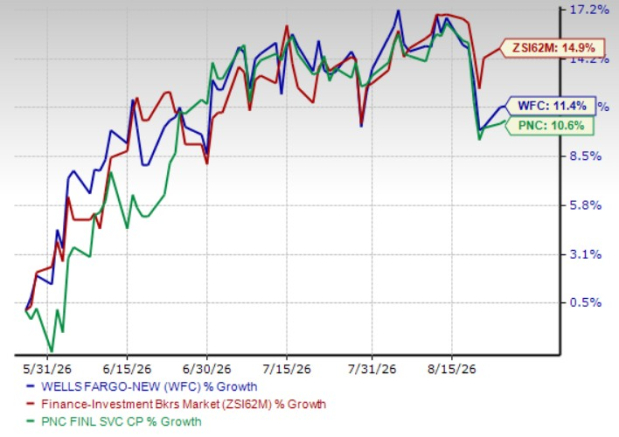
Image Source: Zacks Investment Research
From a valuation standpoint, WFC is currently trading at a forward 12-month price-to-earnings (P/E) multiple of 11.01X, while PNC is trading at 11.85X. Both stocks are trading below the industry average of 13.97X. However, PNC appears relatively more expensive than WFC.
Price-to-Earnings F12M

Image Source: Zacks Investment Research
Meanwhile, both WFC and PNC continue to return capital to shareholders. Post-clearing the Fed’s 2026 stress test, WFC raised its common stock dividend by 11% to 50 cents per share, while PNC increased its quarterly common stock dividend by 18% to $2 per share. WFC offers a dividend yield of 2.36% compared with 3.28% for PNC, giving PNC an edge in terms of shareholder returns.
Dividend Yield

Image Source: Zacks Investment Research
WFC and PNC: Which Offers More Value?
Both Wells Fargo and PNC Financial present compelling investment cases, but their growth strategies and valuation profiles differ. PNC stands out with stronger NII and earnings growth, supported by strong loan expansion, the FirstBank acquisition and continued investments in its geographic footprint. However, this growth comes with higher expenses and integration costs, which could weigh on near-term profitability.
WFC, meanwhile, offers a more balanced investment case, combining improving balance-sheet growth with cost discipline and a multi-year simplification strategy. Its lower forward P/E multiple also provides a valuation advantage over PNC, while its strong ROTCE and continued capital returns add to its appeal.
Although PNC offers a higher dividend yield, WFC’s lower valuation, improving operating efficiency and focus on higher-return businesses, along with upward estimate revision, make it more attractive for investors looking for stable long-term growth.
Both WFC and PNC currently carry a Zacks Rank #3 (Hold). You can see the complete list of today’s Zacks #1 Rank (Strong Buy) stocks here.
Zacks' Research Chief Names "Stock Most Likely to Double"
Our team of experts has just released the 5 stocks with the greatest probability of gaining +100% or more in the coming months. Of those 5, Director of Research Sheraz Mian highlights the one stock set to climb highest.
This top pick is a little-known satellite-based communications firm. Space is projected to become a trillion dollar industry, and this company's customer base is growing fast. Analysts have forecasted a major revenue breakout in 2025. Of course, all our elite picks aren't winners but this one could far surpass earlier Zacks' Stocks Set to Double like Hims & Hers Health, which shot up +209%.
Free: See Our Top Stock And 4 Runners UpWant the latest recommendations from Zacks Investment Research? Today, you can download 7 Best Stocks for the Next 30 Days. Click to get this free report
Wells Fargo & Company (WFC): Free Stock Analysis Report
The PNC Financial Services Group, Inc (PNC): Free Stock Analysis ReportThis article originally published on Zacks Investment Research (zacks.com).
Zacks Investment Research