Recent earnings across the generic drug industry point to a mixed but generally resilient operating environment. Reported sales at several manufacturers were affected by lower contributions from older high-value products, continued price erosion and temporary supply or manufacturing disruptions. However, underlying demand remained healthy in many markets, with new launches, higher volumes and broader geographic contributions helping offset these pressures.
Looking ahead, the industry’s near-term performance is likely to depend increasingly on execution. Companies are focused on restoring disrupted supply, maintaining a steady pace of launches, improving product mix and controlling costs. Although competition and pricing pressure will remain persistent, generic drugmakers generally expect stronger contributions from newer products and improving operating leverage to support sales and earnings growth over the coming quarters.
Here, we highlight three generic drugmakers — Amphastar Pharmaceuticals AMPH, Sandoz SDZNY and Viatris VTRS — that appear well-positioned to capitalize on this evolution within the industry.
Industry Description
The Medical - Generic Drugs industry comprises companies that develop and market chemically/biologically identical versions of a brand-name drug once the patents providing exclusivity to branded drugs expire. These drugs can be divided into generic and biosimilar categories based on their composition. The generic segment is controlled by a few large drugmakers and the generic units of large pharma companies. Several smaller companies also develop generic versions of branded drugs, which are significantly cheaper than the originals. Competition in this segment is stiff, resulting in thin margins for manufacturing companies. A few companies in this industry have some branded drugs in their portfolio, helping them tap a higher-margin market.
3 Trends Shaping the Future of the Generic Drugs Industry
Loss of Patent Exclusivity Creates New Opportunities: Generic drugmakers depend on the loss of patent exclusivity for branded medicines to bring lower-cost alternatives to market. A company may launch an authorized generic version of a branded product, gaining exclusivity over competing generic versions for several months. Such opportunities can be particularly attractive in complex generics, which typically require greater development expertise and investment than traditional generics. Drugmakers also frequently engage in patent litigation to secure earlier entry into the market for generic products.
Beyond traditional generics, the industry's opportunity set is expanding as more blockbuster biologic drugs lose exclusivity. Recent high-profile launches included biosimilars of J&J’s Stelara, Amgen's Prolia/Xgeva and Regeneron's Eylea. Drugmakers are also advancing biosimilar candidates for Merck's blockbuster immunotherapy Keytruda, which is expected to lose patent protection in 2028.
Competition Is Driving a Shift Beyond Traditional Generics: Competition remains intense across the generic drug market. Once a branded drug loses exclusivity, multiple manufacturers often enter the market, leading to price competition and margin pressure. To gain an advantage, drugmakers seek first-to-file (FTF) status, which can provide a period of exclusivity before additional generic competitors enter. Despite these opportunities, the generic market remains crowded, with numerous filings pending before the FDA and several generic and biosimilar launches expected over the next few years.
In response to persistent pricing pressure, companies are increasingly moving beyond commodity generics and investing in differentiated products such as complex generics, specialty injectables and biosimilars. These products typically require greater development expertise and investment but face fewer competitors and offer stronger margins and more durable revenue opportunities than traditional generics.
Operational Efficiency & Portfolio Optimization Remain Key Priorities: With pricing pressure persisting across many generic drug categories, manufacturers are placing greater emphasis on operational efficiency and disciplined capital allocation. Companies are streamlining product portfolios, discontinuing lower-return programs and focusing resources on products and markets with stronger growth potential. Many drugmakers are also investing in manufacturing productivity, supply-chain optimization and cost-control initiatives to protect profitability. These efforts are helping companies offset pricing headwinds in mature generic markets while creating financial flexibility to invest in higher-growth areas such as biosimilars, complex generics and specialty medicines.
Zacks Industry Rank Indicates Gloomy Prospects
The Zacks Medical – Generic Drugs industry is a small 12-stock group housed within the broader Zacks Medical sector.
The group’s Zacks Industry Rank is the average of the Zacks Rank of all the member stocks. The Zacks Medical – Generic Drugs industry currently carries a Zacks Industry Rank #160, placing it in the bottom 35% of the 247 Zacks industries. Our research shows that the top 50% of the Zacks-ranked industries outperform the bottom 50% by a factor of more than 2 :1.
Against this backdrop, we will present a few noteworthy stocks. But before that, let us look at the industry’s stock market performance and current valuation.
Industry Versus Sector & S&P 500
The Zacks Medical – Generic Drugs industry has outperformed the broader Zacks Medical but underperformed the S&P 500 Index in the past year.
The industry has surged about 11% over this period compared with the broader sector’s nearly 7% growth. Meanwhile, the S&P 500 has risen 12%.
One-Year Price Performance
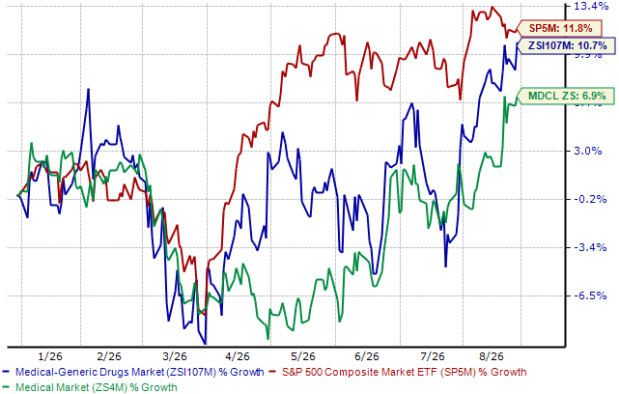
Image Source: Zacks Investment Research
Industry's Current Valuation
Based on the forward 12-month price-to-earnings (P/E F12M), a commonly used multiple for valuing generic companies, the industry is currently trading at 16.75X compared with the S&P 500’s 20.37X and the Zacks Medical sector’s 22.06X.
Over the past five years, the industry has traded as high as 17.02X, as low as 6.51X and at the median of 9.67X, as the charts below show.
P/E F12M Ratio

Image Source: Zacks Investment Research

Image Source: Zacks Investment Research
3 Generic Drug Stocks to Keep an Eye On
Amphastar: The company continues to expand its portfolio of generics and biosimilars. It markets several products, including albuterol, iron sucrose, teriparatide and, most recently, launched ipratropium bromide in April 2026. Ipratropium generated $8.4 million in sales in the second quarter of 2026. Amphastar also has one generic drug and one biosimilar insulin candidate filed with the FDA while developing two additional biosimilars and three generic products. Management is preparing for a potential 2027 launch of its insulin aspart biosimilar, subject to FDA approval. These newer products could help improve margins.
One issue to watch is an FDA warning letter received by one of its manufacturing subsidiaries. Amphastar expects remediation costs of $2 million to $3 million per quarter for the next several quarters, although management continues to expect mid- to high-single-digit sales growth in 2026.
The stock has lost 27% in the past year. The consensus estimate for 2026 EPS has increased from $2.63 to $2.78 per share in the past 30 days.
Amphastar carries a Zacks Rank #3 (Hold) at present. You can see the complete list of today’s Zacks #1 Rank (Strong Buy) stocks here.
Price & Consensus: AMPH

Image Source: Zacks Investment Research
Sandoz: The Swiss-based generic and biosimilar drugmaker, spun off from Novartis in 2023, reported first-half 2026 net sales of $5.76 billion, up 5% year over year at constant currencies. Growth was driven by its biosimilars business, where sales increased 20% to $1.88 billion and accounted for a record 33% of total revenues. Recent launches were a major contributor, particularly Afqlir (biosimilar to Eylea), Jubbonti (biosimilar to Amgen’s Prolia) and Wyost (biosimilar to Amgen’s Xgeva). Sandoz expects 2026 sales to grow at a mid- to high-single-digit rate, supported by recent product launches and continued biosimilar momentum.
The company is continuing to expand its biosimilars pipeline, which now includes 36 assets. Sandoz has also begun expanding into the fast-growing GLP-1 market: its semaglutide product received approval in Brazil last month, with a launch planned for later in 2026, while the FDA has accepted for review two applications for its proposed generic tirzepatide autoinjectors. Management expects the GLP-1 opportunity to become more meaningful in 2027 and 2028.
In the past year, the stock has climbed 39%. The consensus estimate for 2026 EPS has increased from $4.10 to $4.11 in the past 30 days. Sandoz currently carries a Zacks Rank #3.
Price & Consensus: SDZNY

Image Source: Zacks Investment Research
Viatris: It offers a broad mix of generics, including oral solids, injectables and transdermal products, with increasing emphasis on higher-value complex generics. Growth is being supported by products such as estradiol patches, octreotide and iron sucrose, while the company continues to expand its pipeline of complex injectables. Viatris secured 70 generic approvals in the first half of 2026 and expects more than 100 approvals for the full year.
Viatris’ sizeable branded portfolio provides additional diversification, with established products such as Creon and its cardiovascular brands in Greater China supporting growth. Together, the branded business and expanding complex-generics portfolio provide multiple revenue drivers, although competition and manufacturing-related supply disruptions remain near-term risks.
The stock has surged 62% in the past year. The consensus estimate for 2026 EPS has increased from $2.46 to $2.49 in the past 30 days. Viatris carries a Zacks Rank #3 at present.
Price & Consensus: VTRS

Image Source: Zacks Investment Research
7 Best Stocks for the Next 30 Days
Just released: Experts distill 7 elite stocks from the current list of 220 Zacks Rank #1 Strong Buys. They deem these tickers "Most Likely for Early Price Pops."
Since 1988, the full list has beaten the market more than 2X over with an average gain of +23.9% per year. So be sure to give these hand picked 7 your immediate attention.
See them now >>Want the latest recommendations from Zacks Investment Research? Today, you can download 7 Best Stocks for the Next 30 Days. Click to get this free report
Amphastar Pharmaceuticals, Inc. (AMPH): Free Stock Analysis Report
Viatris Inc. (VTRS): Free Stock Analysis Report
Sandoz Group AG Sponsored ADR (SDZNY): Free Stock Analysis ReportThis article originally published on Zacks Investment Research (zacks.com).
Zacks Investment Research