Geospace Technologies Corporation GEOS investors have been experiencing some short-term losses from the stock of late. Shares of the Houston, TX-based technology and instrumentation manufacturer have plunged 41.8% in the past three months compared with the industry’s 10.3% decline. The stock also underperformed the sector and the S&P 500’s 5.1% decline and 0.1% gain, respectively, in the same time frame.
Recent developments at Geospace include the delivery of 4,000 Pioneer land seismic acquisition nodes to Faraday Geophysics, an integrated geophysical services and technology company operating across the Americas, and the announcement of its third-quarter fiscal 2026 results (both in August).
In the fiscal third quarter, the company reported lower sales due to challenging market conditions, project timing, softer sales volumes and customer access to capital. Geospace operates through Smart Water, Energy Solutions and Intelligent Industrial. Smart Water was hurt by weaker Hydroconn demand, Energy Solutions faced lower seismic-equipment demand and delayed permanent reservoir monitoring (PRM) contributions, while Intelligent Industrial was pressured by softer industrial sensor and contract manufacturing demand.
Management highlighted cost reductions and manufacturing productivity improvements, along with the Series V connector and security opportunities. GEOS has entered full production on the PRM contract and remains focused on converting its pipeline into revenue and improving operating performance.
GEOS’ Three-Month Price Comparison

Image Source: Zacks Investment Research
Over the past three months, the stock’s performance has remained weak, underperforming that of its peers like Aehr Test Systems AEHR and Trio-Tech International TRT. Aehr and Trio-Tech’s shares have lost 34.7% and 18.4%, respectively, in the same time frame.
Geospace’s Smart Water segment primarily generates revenues from product sales. The Energy Solutions segment generates revenues from product sales, rentals and services, while the Intelligent Industrial segment generates revenues from product sales and services.
GEOS’ Demand Weakness Across Core Markets
Geospace’s Smart Water business continues to face reduced demand for its Hydroconn connector product line, particularly the Series III connector. This weakness has persisted across both the third quarter of fiscal 2026 and the year-to-date period, indicating that the pressure is not confined to a single quarter. The Series V connector broadens compatibility and addresses supply-chain challenges, but improvement in Smart Water ultimately depends on stronger customer ordering and successful adoption of the expanded offering.
Energy Solutions continues to contend with reduced demand for seismic acquisition equipment, including weaker market demand for ocean-bottom nodal products. Broader geopolitical uncertainty and customers’ access to capital are also affecting sales volumes and purchasing decisions. These conditions can restrain near-term equipment spending and leave the segment exposed to fluctuations in exploration activity and customer investment priorities.
Intelligent Industrial is also experiencing softer demand, limiting its ability to counter weakness in the other businesses. Demand for industrial sensors declined across both the third quarter of fiscal 2026 and the year-to-date period, while contract manufacturing services also weakened during the quarter. Continued softness across these offerings could constrain the segment’s near-term contribution despite opportunities within Geospace’s security portfolio.
Geospace’s Execution and Financial Risks
Geospace’s growth pipeline includes sizable PRM and government opportunities, but the timing of their conversion into revenues remains uncertain. Customer-requested engineering changes delayed the existing PRM program, while management said there is no firm timetable for another PRM proposal. Government opportunities can also involve lengthy sales cycles, potentially creating uneven revenue realization and limiting near-term visibility.
Geospace continues to use cash from operations amid weak business conditions, while margins are being pressured by product mix, inflation, raw-material costs and component availability. Management is closely controlling expenses and monitoring cash flows, with the credit facility providing additional financial flexibility until anticipated customer payments arrive. Sustained cash usage could remain a concern if the expected revenue recovery takes longer to materialize.
GEOS’ Growth Drivers
Geospace’s security portfolio offers meaningful growth potential, supported by new government programs and a pipeline of opportunities, including its Heartbeat Detector, though government sales cycles may extend conversion timelines. Additionally, Energy Solutions could benefit from PRM execution and expanding seismic opportunities, with the existing PRM contract in production and continued customer interest in advanced seismic acquisition technologies supporting future demand.
Geospace Stock’s Valuation
Geospace’s trailing 12-month EV/Sales of 0.7X is lower than the industry’s average of 7.3X and its five-year median of 0.8X.
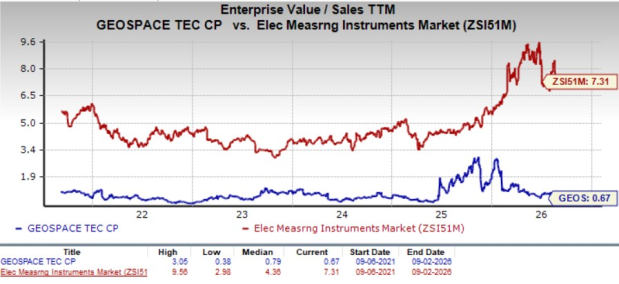
Image Source: Zacks Investment Research
Aehr and Trio-Tech’s trailing 12-month EV/Sales currently stand at 48.2X and 1.6X, respectively, in the same time frame.
Our Final Take on GEOS
Geospace’s steep share-price decline reflects the near-term operational and financial pressures surrounding the business. While these challenges could continue to weigh on sentiment, the company retains longer-term opportunities across its diversified technology portfolio.
Progress in security, PRM and seismic solutions provides potential avenues for recovery. However, the investment case increasingly depends on Geospace converting these opportunities into more consistent operating performance.
From a valuation standpoint, GEOS appears inexpensive compared with its peers and is also trading below its historical valuation level. This suggests that considerable concern around its near-term outlook is already embedded in the stock price. However, the valuation discount may persist until Geospace demonstrates clearer improvement in its operating performance. Investors are likely to require clearer evidence of improving demand, better cash generation and more consistent conversion of the project pipeline before assigning the stock a meaningfully higher valuation.
For existing shareholders, Geospace’s growth opportunities support holding the stock, but the operational uncertainties warrant patience. Prospective investors may prefer to wait for clearer signs of business stabilization before taking a position. A sustained recovery will likely depend on improved demand, stronger project execution and easing financial pressures.
Research Chief Names "Single Best Pick to Double"
From thousands of stocks, 5 Zacks experts each have chosen their favorite to skyrocket +100% or more in months to come. From those 5, Director of Research Sheraz Mian hand-picks one to have the most explosive upside of all.
This company targets millennial and Gen Z audiences, generating nearly $1 billion in revenue last quarter alone. A recent pullback makes now an ideal time to jump aboard. Of course, all our elite picks aren’t winners but this one could far surpass earlier Zacks’ Stocks Set to Double like Nano-X Imaging which shot up +129.6% in little more than 9 months.
Free: See Our Top Stock And 4 Runners UpWant the latest recommendations from Zacks Investment Research? Today, you can download 7 Best Stocks for the Next 30 Days. Click to get this free report
Geospace Technologies Corporation (GEOS): Free Stock Analysis Report
Aehr Test Systems (AEHR): Free Stock Analysis Report
Trio-Tech International (TRT): Free Stock Analysis ReportThis article originally published on Zacks Investment Research (zacks.com).
Zacks Investment Research