The U.S. Retail – Apparel and Shoes industry is seeing selective growth, supported by resilient consumer spending, rising demand for performance footwear, comfort-driven styles, denim and other functional categories. Product innovation, premiumization and growing health and fitness awareness are supporting technical footwear and athleisure, while digital and direct-to-consumer expansion is widening customer reach. However, consumers are more price-sensitive, promotions are elevated, and tariffs continue to pressure sourcing and margins. Even so, brands with differentiated products, strong omnichannel capabilities and disciplined inventory management remain well placed to capture demand and gain market share.
Within this backdrop, The Cato Corporation CATO and Lulu's Fashion Lounge Holdings, Inc. LVLU represent two U.S.-based women’s fashion retailers that generate revenue primarily from the sale of apparel, footwear, and accessories through their respective retail and digital channels.
On one hand, Cato operates fashion specialty stores and e-commerce sites across the United States under brands such as Cato, It’s Fashion and Versona. It sells value-priced apparel, footwear, jewelry, handbags and accessories, with many items offered under private labels. The company also provides proprietary credit-card and layaway programs and distributes merchandise through its Charlotte, North Carolina facility.
In contrast, Lulus is a digitally native women’s fashion retailer offering apparel, footwear and accessories at accessible prices, mainly to Gen Z and Millennial customers. It sells primarily through its website and mobile app, using data-driven merchandising and a “test, learn and reorder” model. The company also expands through wholesale partnerships, social media marketing and international sales.
While both companies operate in the women’s apparel retail industry, Cato’s store-heavy value retail model and broader brand portfolio differ from Lulus’ digitally native, direct-to-consumer approach and younger customer focus, creating distinct competitive positions and operating risk profiles. This raises an important question for investors: Which company is better positioned today? Let's take a closer look.
Stock Performance & Valuation: CATO vs LVLU
LVLU (up 128.5%) has outperformed CATO (down 15.9%) over the year-to-date period.
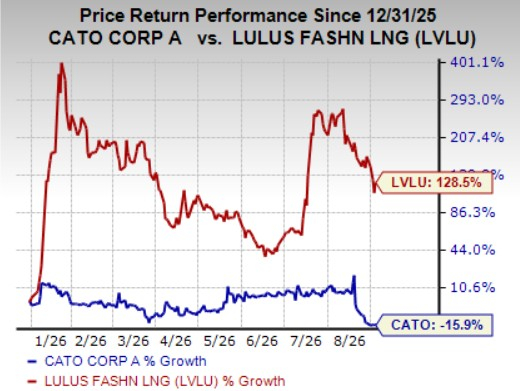
Image Source: Zacks Investment Research
Meanwhile, CATO is trading at a trailing 12-month price-to-sales (P/S) ratio of 0.08X, below its median of 0.19X over the past five years. LVLU’s trailing sales multiple sits at 0.13X, below its last five-year median of 0.2X. CATO and LVLU both appear to be cheap when compared with the Zacks Retail – Apparel and Shoes industry’s average of 1.35X.
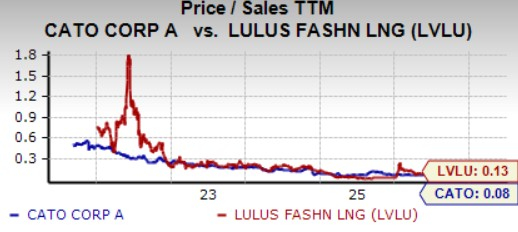
Image Source: Zacks Investment Research
Factors Driving Cato’s Stock
Expense discipline is helping Cato cushion the impact of softer sales. Selling, general and administrative expenses declined to $108 million for the first six months of fiscal 2026 from $112.7 million. Management attributed the improvement mainly to lower payroll and equipment costs. A leaner cost base, alongside lower depreciation expense, could support earnings resilience as the company adjusts its store base and works through demand pressure.
Cato’s multi-banner retail platform and integrated credit operations provide additional support to its business model. The Cato, It’s Fashion and Versona banners sell women’s apparel, shoes and accessories through shared sourcing and a single distribution center, offering potential operating efficiencies. Its proprietary credit card business also remained profitable, generating segment pretax income in the first six month-period, while planned new-store openings can selectively extend the company’s reach.
Strong liquidity provides Cato with flexibility to navigate a soft retail backdrop and fund strategic needs. Cash provided by operations rose to $22.5 million in the first six months of fiscal 2026 from $15.6 million a year earlier, while working capital increased to $55 million from $37.4 million at fiscal year-end. The company also had no borrowings under its revolving credit facility and retained $27 million of available capacity after an outstanding letter of credit, supporting operating and capital needs.
Factors Driving Lulus’ Stock
Lulus is benefiting from stronger merchandise economics, with gross margin expanding despite lower sales. For the twenty-six weeks ended June 28, 2026, gross margin improved to 47% from 43.1% a year earlier, even as revenues declined. The improvement reflected a shift toward higher-margin products and freight savings from better shipping rates. This favorable merchandise mix and lower fulfillment costs helped limit the decline in gross profit and can support profitability if demand conditions improve.
Cost discipline is also improving Lulus’ earnings profile. Selling and marketing expenses declined as the company reduced marketing costs and merchant processing fees, while general and administrative expenses benefited from lower labor costs, reduced fixed headcount and lower equity-based compensation. These actions helped narrow the net loss and lift adjusted EBITDA and its margin year over year, indicating better expense control and a stronger operating foundation. This could enhance operating leverage if sales stabilize.
Lulus is also seeing support from working-capital management and liquidity. Net cash provided by operating activities increased to $7.5 million in the first twenty-six weeks of 2026, aided in part by a $3.8 million inventory reduction tied to its inventory optimization plan. Cash balances increased over the period, while management said cash on hand, operating cash flow and availability under its credit facility should be sufficient to meet obligations for at least the next 12 months. This supports near-term financial flexibility.
Choose CATO Over LVLU Now
Cato appears to have the edge over Lulus at present, backed by a more compelling valuation, solid liquidity and disciplined cost management. Although LVLU has significantly outperformed CATO year to date, Cato’s lower trailing P/S multiple makes the stock more attractive from a value standpoint. The company is also benefiting from lower selling, general and administrative expenses, which are helping cushion the impact of softer sales and support earnings performance in a challenging retail environment.
Cato’s healthy financial position adds to its investment appeal. Higher operating cash flow, increased working capital and the absence of borrowings under its revolving credit facility provide ample flexibility to navigate near-term demand pressures. Its diversified banner portfolio, shared sourcing and distribution platform, and profitable credit operations offer additional support.
Lulus, on the other hand, is making notable progress on margins and costs. Gross-margin expansion, lower marketing and administrative expenses, inventory optimization and improved adjusted EBITDA point to better operating efficiency. However, persistent sales declines remain a concern and could limit the benefits of these initiatives unless demand stabilizes.
Given these factors, CATO looks like the better investment option right now. LVLU’s improving profitability metrics and strong share-price momentum make its turnaround worth watching, but continued revenue weakness keeps execution risk elevated. Cato’s cheaper valuation, stronger liquidity and better financial flexibility provide a more favorable risk-reward profile, giving it the advantage over LVLU at present.
Research Chief Names "Single Best Pick to Double"
From thousands of stocks, 5 Zacks experts each have chosen their favorite to skyrocket +100% or more in months to come. From those 5, Director of Research Sheraz Mian hand-picks one to have the most explosive upside of all.
This company targets millennial and Gen Z audiences, generating nearly $1 billion in revenue last quarter alone. A recent pullback makes now an ideal time to jump aboard. Of course, all our elite picks aren’t winners but this one could far surpass earlier Zacks’ Stocks Set to Double like Nano-X Imaging which shot up +129.6% in little more than 9 months.
Free: See Our Top Stock And 4 Runners UpWant the latest recommendations from Zacks Investment Research? Today, you can download 7 Best Stocks for the Next 30 Days. Click to get this free report
Cato Corporation (The) (CATO): Free Stock Analysis Report
Lulu's Fashion Lounge Holdings, Inc. (LVLU): Free Stock Analysis ReportThis article originally published on Zacks Investment Research (zacks.com).
Zacks Investment Research