Robinhood Markets HOOD and Charles Schwab SCHW are two prominent players in the brokerage space, but their business models and investment profiles differ considerably.
HOOD is a digital-first brokerage focused on expanding its reach among retail investors through trading, crypto, prediction markets, retirement, advisory and banking products. SCHW, meanwhile, operates a much larger and more diversified financial services platform spanning brokerage, wealth management, banking, lending and asset management.
With both Robinhood and Schwab benefiting from rising client assets and engagement, let’s check out their fundamentals to determine which stock is the better investment now.
The Case for Robinhood
Robinhood continues to benefit from robust customer asset growth and expanding engagement. As of August 2026, funded customers totaled 28.6 million, up 7% year over year, while platform assets increased 26% to $383.7 billion. Equity notional trading volumes surged 68% year over year. Crypto volumes also rebounded sharply from July, although options and event-contract activity softened sequentially.
The company's long-term growth strategy extends well beyond commission-free equity trading. Robinhood is expanding across retirement, credit cards, advisory services, prediction markets, international markets and tokenized assets. These initiatives are expected to broaden the revenue base, deepen customer relationships and increase the share of client financial activity captured by its ecosystem.
First-half 2026 results also highlighted HOOD's operating momentum. Revenues reached a record $2.41 billion, supported by strength in trading and higher platform assets. Product expansion, solid net deposits and a growing base of interest-earning assets will likely continue to support the top line.
Nevertheless, Robinhood's business carries meaningful risks. Trading revenues remain sensitive to retail-investor activity, crypto markets can be volatile and expansion into products such as prediction markets and tokenized equities introduces additional regulatory uncertainty.
The Case for Schwab
Schwab's biggest advantage is the scale and diversity of its franchise. At the end of July 2026, the company had $13.04 trillion in total client assets, 39.9 million active brokerage accounts, 5.9 million workplace plan participant accounts and 2.4 million banking accounts.
Schwab is also broadening its business beyond traditional brokerage through wealth management, lending, banking, active trading and digital assets. Its huge existing client base offers substantial cross-selling opportunities without requiring proportionate increases in customer acquisition spending.
Fundamentals remain healthy. First-half 2026 revenues climbed 18% year over year to a record $13.6 billion, while adjusted earnings jumped 41% to $3.05 per share. Higher net interest revenues, asset-management fees and trading revenues are supporting results.
Still, Schwab faces risks related to interest-rate movements, client cash allocation and funding costs. Its mature scale also means that it is unlikely to match Robinhood's percentage growth over the long run.
Robinhood & Schwab: Earnings Estimates
The Zacks Consensus Estimate for Schwab's 2026 earnings is pegged at $6.46 per share, suggesting 32.7% growth from the prior year. Earnings are projected to rise another 21.2% to $7.83 in 2027. The 2026 and 2027 consensus estimates have moved higher over the past 60 days, indicating improving analyst confidence.
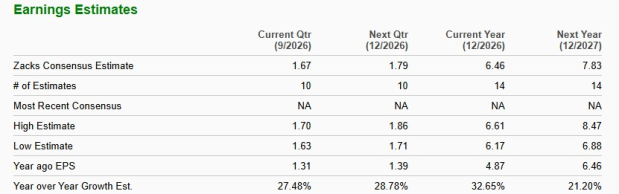
Image Source: Zacks Investment Research
For Robinhood, the Zacks Consensus Estimate for 2026 earnings is $2.11 per share, suggesting growth of 2.9%. Earnings are projected to jump 33% to $2.81 in 2027. Estimates for both years have moved higher over the past 30 days, which is encouraging.
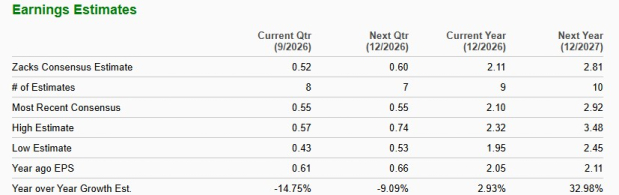
Image Source: Zacks Investment Research
Schwab has the edge in earnings momentum as HOOD’s near-term earnings growth remains substantially below Schwab's expected pace.
Robinhood or Schwab: Which Stock is Inexpensive?
Robinhood's rapid growth comes at a steep price. HOOD currently trades at a 12-month trailing price-to-tangible book (P/TB) multiple of 11.88X, significantly above the industry's 3.35X. Schwab is not inexpensive relative to its industry either. Its trailing P/TB ratio is 7.66X at present.
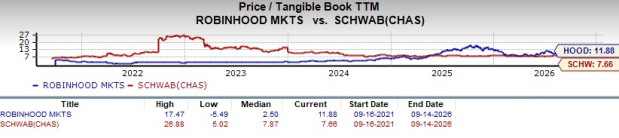
Image Source: Zacks Investment Research
Schwab trades at a considerable discount to Robinhood despite its strong earnings growth and diversified business model.
HOOD or SCHW: Which is Leading in Price Performance?
Share price performance has also favored Schwab this year, with SCHW stock rising 7.4%, compared with only 1.1% for HOOD.
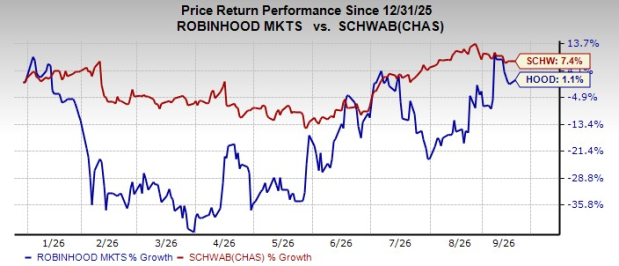
Image Source: Zacks Investment Research
Robinhood, however, has displayed significantly stronger recent momentum. HOOD’s shares have soared 51.8% over the past six months, outperforming Schwab's 14.6% rally. This suggests investor enthusiasm surrounding Robinhood’s expanding product lineup remains strong despite relatively muted year-to-date performance.
Robinhood or Schwab: Which One is Worth Considering?
Robinhood's growth story remains compelling. Rising customer assets, strong trading engagement, product innovation and expansion into crypto, retirement, advisory, prediction markets and international markets provide substantial long-term opportunities. However, premium valuation leaves less room for execution missteps, while regulatory uncertainty and its greater sensitivity to trading activity add to the risk profile.
Schwab, in contrast, offers a more balanced investment case. Robust asset gathering, improving net interest revenues, expanding wealth-management opportunities and a diversified revenue mix provide stronger earnings visibility. Its relatively more reasonable valuation further improves the risk-reward proposition.
On balance, SCHW is the stronger investment choice at current levels. HOOD may deliver greater upside if its growth initiatives continue to outperform expectations, but that potential comes with higher valuation and execution risk. Schwab offers a more compelling combination of earnings momentum, valuation support, business diversification and financial resilience. For investors seeking the better risk-adjusted opportunity in the brokerage space, SCHW gets the nod over HOOD.
Robinhood and Schwab both currently carry a Zacks Rank #3 (Hold). You can see the complete list of today’s Zacks #1 Rank (Strong Buy) stocks here.
7 Best Stocks for the Next 30 Days
Just released: Experts distill 7 elite stocks from the current list of 220 Zacks Rank #1 Strong Buys. They deem these tickers "Most Likely for Early Price Pops."
Since 1988, the full list has beaten the market more than 2X over with an average gain of +23.9% per year. So be sure to give these hand picked 7 your immediate attention.
See them now >>Want the latest recommendations from Zacks Investment Research? Today, you can download 7 Best Stocks for the Next 30 Days. Click to get this free report
The Charles Schwab Corporation (SCHW): Free Stock Analysis Report
Robinhood Markets, Inc. (HOOD): Free Stock Analysis ReportThis article originally published on Zacks Investment Research (zacks.com).
Zacks Investment Research