Credo Technology Group Holding Ltd CRDO is positioning its OmniConnect platform as an emerging opportunity tied directly to the expanding requirements of AI inference. As next-generation AI architectures demand greater memory capacity and bandwidth, memory fanout is becoming an increasingly important constraint. Credo stated these limitations can restrict both available bandwidth and the amount of memory that can be deployed, two factors that are critical for high-performance inference.
To address this challenge, the company has developed OmniConnect SerDes and Weaver gearbox solutions, with management expecting the platform to begin contributing revenues in fiscal 2028. Credo also believes OmniConnect could represent thousands of dollars of content per GPU.
The OmniConnect architecture consists of two main elements. First, Credo licenses a highly optimized, high-speed SerDes designed for a small footprint, low power consumption and reach of up to 10 inches. This is intended to address fanout constraints around the XPU while increasing the distance possible between the GPU and memory. The second element is the Weaver gearbox, which interfaces with the embedded SerDes and converts the connection into an LPDDR interface. Credo plans to launch an LPDDR5 version first, followed by LPDDR6. This approach could allow XPU partners to transition between memory generations by changing the gearbox rather than requiring another XPU tape-out.
On the last earnings call, Credo highlighted Positron as its first OmniConnect customer. Management noted that Positron’s announced product can increase memory capacity to as much as 2 terabytes, enabling frontier models to keep more data in memory and potentially improve inference performance. Credo also said its roadmap is designed to deliver bandwidth comparable to HBM5 while increasing memory capacity and avoiding some reliability challenges associated with packaging XPUs and HBM together.
The opportunity could become meaningful if customer adoption develops as expected. Credo has previously described OmniConnect as a multibillion-dollar annual opportunity and sees strong engagement around the technology. With revenues expected to begin in fiscal 2028, OmniConnect could add another growth avenue alongside the company’s existing connectivity portfolio, particularly as inference architectures place greater emphasis on memory bandwidth, capacity, packaging and cost.
Taking a Look at CRDO’s Competitors
Marvell Technology MRVL is benefiting from rising AI infrastructure demand, with custom silicon, interconnect, switching and optics supporting record data center revenues and a higher multi-year outlook. Management now expects faster growth through fiscal 2028 as custom programs broaden and scale-up networking gains traction. The NVIDIA relationship and recent acquisitions expand Marvell’s role across next-generation AI architectures, while the communications and other segment provides some diversification. For the third quarter of fiscal 2027, Marvell Technology forecasts revenues of $3.15 billion (+/-5%), implying about 15% sequential growth at the midpoint. Management raised its fiscal 2027 revenue outlook to roughly $12 billion, suggesting about 45% growth, from the prior view of approximately $11.5 billion.
Astera Labs ALAB is benefiting from rising demand for high-speed connectivity as AI infrastructure shifts toward larger rack-scale systems. PCIe 6 adoption is expanding across Aries and Scorpio, while the Scorpio X-Series has moved into volume production and is expected to become the company’s largest product family. Taurus, CXL, UALink, optical and custom connectivity programs broaden the longer-term content opportunity. Liquidity remains ample, and revenue growth is translating into operating leverage. For the third quarter of 2026, revenues are expected to be between $540 million and $560 million. The midpoint implies sequential growth of approximately 40%, driven by the Scorpio X-Series production ramp, continued Aries PCIe 6 retimer strength and preproduction Taurus shipments for 800-gigabit Ethernet applications.
CRDO Price Performance, Valuation and Estimates
Shares of CRDO are down 46.9% in the past month compared with the Electronics-Semiconductors industry’s decline of 9.5%.
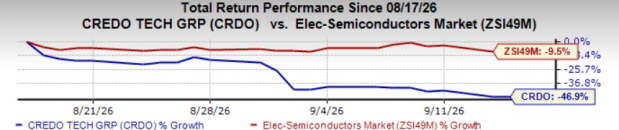
Image Source: Zacks Investment Research
CRDO is trading at a forward 12-month price/earnings ratio of 24.01, higher than the Electronics-Semiconductors sector’s multiple of 12.79.
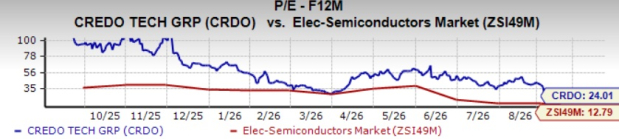
Image Source: Zacks Investment Research
The Zacks Consensus Estimate for CRDO earnings for fiscal 2027 has seen a marginal upward revision over the past 60 days.
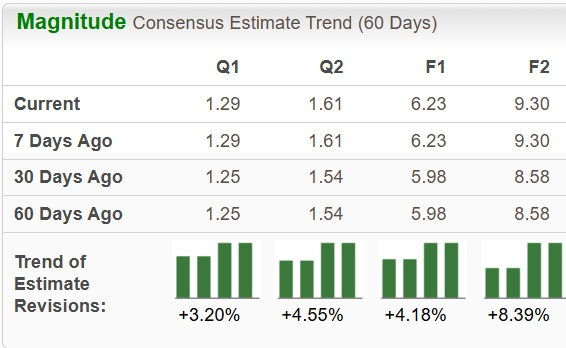
Image Source: Zacks Investment Research
CRDO currently carries a Zacks Rank #3 (Hold). You can see the complete list of today’s Zacks #1 Rank (Strong Buy) stocks here.
7 Best Stocks for the Next 30 Days
Just released: Experts distill 7 elite stocks from the current list of 220 Zacks Rank #1 Strong Buys. They deem these tickers "Most Likely for Early Price Pops."
Since 1988, the full list has beaten the market more than 2X over with an average gain of +23.9% per year. So be sure to give these hand picked 7 your immediate attention.
See them now >>Want the latest recommendations from Zacks Investment Research? Today, you can download 7 Best Stocks for the Next 30 Days. Click to get this free report
Credo Technology Group Holding Ltd. (CRDO): Free Stock Analysis Report
Marvell Technology, Inc. (MRVL): Free Stock Analysis Report
Astera Labs, Inc. (ALAB): Free Stock Analysis ReportThis article originally published on Zacks Investment Research (zacks.com).
Zacks Investment Research