United Rentals URI, the world’s largest equipment rental company, has witnessed a sharp pullback, with its stock declining 14.7% over the past month. The stock underperformed the 11% decline of the Zacks Building Products - Miscellaneous Industry, the 9.4% fall of the broader Zacks Construction sector and the 1.1% decline of the S&P 500 Index. The weakness comes despite United Rentals’ leading market position, extensive rental network and diversified exposure to construction and industrial end markets. The company operates an integrated network of 1,774 rental locations and has a fleet with an original equipment cost of about $23.8 billion.
The recent pullback comes as investors weigh robust demand against lingering profitability pressures. Large-project activity remains healthy, but higher fuel and delivery costs, fleet repositioning expenses and a greater mix of lower-margin ancillary and re-rent revenues are creating margin headwinds. Meanwhile, United Rentals is stepping up fleet investment to meet stronger demand, increasing capital requirements even as management remains focused on capital efficiency. These factors make it important to assess whether URI’s recent correction offers an attractive entry point or warrants continued caution.
URI’s One-Month Price Performance
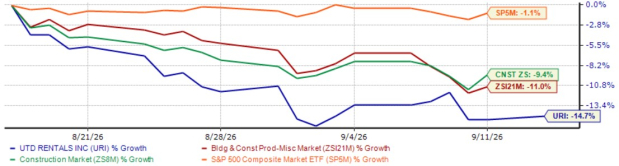
Image Source: Zacks Investment Research
Over the past month, URI underperformed Gibraltar Industries, Inc. ROCK, which declined 5.3%, but fared better than Everus Construction Group, Inc. ECG and Argan, Inc. AGX, which fell 22.4% and 33.4%, respectively.
United Rentals’ Growth Strategy Remains Intact Despite Margin Pressures
Despite near-term margin pressures, United Rentals continues to demonstrate healthy underlying demand. Large projects remain a key growth engine, with strength across nonresidential construction, infrastructure and industrial markets. Power remains an important source of growth, while data centers, hospitals, airports and LNG terminals are also supporting activity. Management indicated that large projects drove first-half demand and expects that momentum to continue through the second half.
Fleet expansion and Specialty growth provide additional opportunities. Historically high time utilization has prompted United Rentals to add fleet capacity to meet stronger customer demand. In the second quarter, Specialty equipment rental revenues jumped 24.8% year over year compared with 6.6% growth in General Rentals. Management also raised its 2026 revenue, adjusted EBITDA and operating cash flow outlooks, reflecting stronger-than-expected demand, large-project activity and customer backlogs.
United Rentals’ Scale and Cash Flow Strength Support Returns
United Rentals’ scale, broad fleet and diversified rental platform remain important competitive advantages. Second-quarter revenues reached a record $4.41 billion, while adjusted EBITDA increased 13.6% to $2.06 billion. Adjusted EPS came in at $12.76, while fleet productivity increased 3.4%, reflecting the combined impact of rental rates, time utilization and mix.
Cash generation also remains a key strength. Operating cash flow increased 20.1% year over year to $3.31 billion during the first six months of 2026, while free cash flow totaled $1.15 billion despite elevated fleet investment. United Rentals ended June with a net leverage ratio of 1.8 times and nearly $3 billion of liquidity, providing considerable flexibility to fund growth and return capital to shareholders.
The company returned $998 million to shareholders during the first half, comprising $750 million of share repurchases and $248 million of dividends. Management continues to target $1.5 billion of share repurchases for 2026, while maintaining its full-year free cash flow outlook of $2.15-$2.45 billion.
United Rentals Faces Margin and Cost Pressures
Despite strong top-line momentum, profitability faces some near-term pressure. Excluding the gain from the sale of part of its scaffolding business, second-quarter adjusted EBITDA margin declined 40 basis points year over year. Specialty Rentals gross margin fell 140 basis points, primarily because lower-margin ancillary and re-rent revenues grew faster and altered the revenue mix.
United Rentals is also navigating inflation, higher fuel and delivery costs, and fleet repositioning expenses associated with supporting large projects. Although management has made progress on cost control, these factors could continue to create margin variability. The company has also increased fleet spending to meet stronger demand, raising 2026 gross rental capital expenditure guidance to $4.85-$5.25 billion from $4.4-$4.8 billion.
Higher capital requirements could limit incremental free cash flow upside even as operating cash generation improves. Continued execution on pricing, fleet productivity, cost efficiencies and capital discipline will therefore be important for United Rentals to translate robust demand into sustainable earnings and cash flow growth.
Earnings Estimate Trend of URI
URI’s earnings estimates for 2026 and 2027 have moved upward over the past seven days to $48.70 and $56.04 per share, respectively. The revised estimates imply year-over-year earnings growth of 15.8% and 15.1%, respectively.

Image Source: Zacks Investment Research
Meanwhile, Gibraltar’s earnings are expected to decline 2% in the current year, while Everus Construction Group and Argan are projected to deliver year-over-year earnings growth of 32.9% and 39.2%, respectively.
URI Stock Trades at a Premium
URI stock is currently trading at a premium to its industry peers, with a forward 12-month price-to-earnings ratio of 18.44, as the trend lines below suggest. The premium indicates that investors continue to assign value to United Rentals’ scale, market leadership, strong cash generation and growth prospects. However, despite the recent share-price correction, the valuation does not necessarily point to a deeply discounted entry level, making earnings growth and execution increasingly important in determining further upside.
URI P/E Ratio (Forward 12 Months)
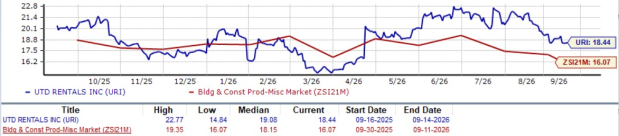
Image Source: Zacks Investment Research
Wrapping Up
United Rentals’ long-term growth prospects remain supported by robust large-project demand, strength across nonresidential construction, infrastructure and industrial markets, and continued expansion in Specialty rentals. Healthy fleet productivity, strong cash generation and disciplined capital allocation provide additional support. However, margin pressure from lower-margin ancillary and re-rent revenues, higher fuel and delivery costs, fleet repositioning expenses and elevated capital spending remain near-term concerns. URI also trades at a premium valuation relative to industry peers, which raises the execution bar. At the same time, earnings estimates for both 2026 and 2027 have moved higher, supporting confidence in the company’s earnings trajectory.
Overall, strong demand visibility, positive earnings revisions and healthy free cash flow argue against a bearish stance. The recent pullback may offer a more attractive entry point for investors willing to look past near-term margin pressures.
URI stock currently carries a Zacks Rank #2 (Buy). You can see the complete list of today’s Zacks #1 Rank (Strong Buy) stocks here.
7 Best Stocks for the Next 30 Days
Just released: Experts distill 7 elite stocks from the current list of 220 Zacks Rank #1 Strong Buys. They deem these tickers "Most Likely for Early Price Pops."
Since 1988, the full list has beaten the market more than 2X over with an average gain of +23.9% per year. So be sure to give these hand picked 7 your immediate attention.
See them now >>Want the latest recommendations from Zacks Investment Research? Today, you can download 7 Best Stocks for the Next 30 Days. Click to get this free report
United Rentals, Inc. (URI): Free Stock Analysis Report
Gibraltar Industries, Inc. (ROCK): Free Stock Analysis Report
Argan, Inc. (AGX): Free Stock Analysis Report
Everus Construction Group, Inc. (ECG): Free Stock Analysis ReportThis article originally published on Zacks Investment Research (zacks.com).
Zacks Investment Research