Wells Fargo & Company WFC shares have gained 20.5% over the past three months, outpacing the industry’s 16.1% growth. Its peers, Bank of America BAC and Citigroup C, have risen 30% and 10.2%, respectively, over the same period.
Price Performance
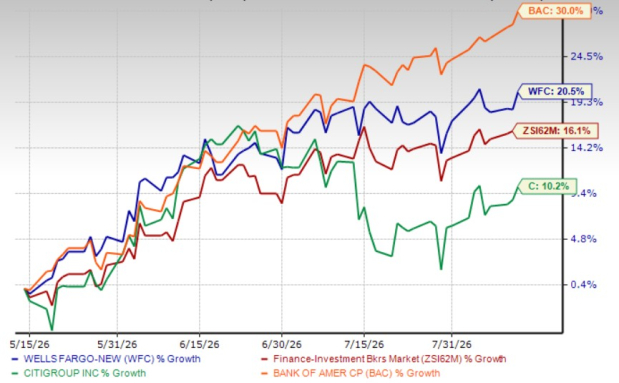
Image Source: Zacks Investment Research
Also, the Zacks Consensus Estimate for WFC’s 2026 and 2027 earnings indicates 15.5% and 9.5% year-over-year rallies, respectively. Estimates for 2026 and 2027 have been revised upward over the past month, signaling growing analyst confidence in the bank’s earnings prospects.
Estimate Revision Trend

Image Source: Zacks Investment Research
With WFC shares already delivering solid gains and earnings estimates continuing to move higher, investors may wonder whether the stock still offers an attractive entry point or whether it would be prudent to wait for a pullback.
To assess the stock’s risk-reward profile, it is important to look beyond recent price momentum and examine Wells Fargo’s underlying fundamentals, earnings drivers, valuation and growth prospects. Let’s take a closer look at whether the bank’s improving outlook justifies buying the stock at current levels or waiting for a better entry point.
Key Catalysts Driving WFC’s Performance
Asset Cap Removal Supports Growth: Wells Fargo reached a pivotal moment in June 2025 as the Federal Reserve lifted the asset cap imposed in 2018 following its fake account scandal. Therestriction had limited the amount of assets the company could hold, constraining growth in loans, deposits and other businesses. With the cap removed, WFC is now well-positioned to expand deposits, grow its loan portfolio and increase securities holdings, setting the stage for stronger financial performance and long-term strategic gains.
In the second quarter of 2026 earnings release, CEO Charlie Scharf also highlighted the significance of the regulatory change, stating that Wells Fargo now has the “opportunity to grow in ways we could not while the asset cap was in place.” The removal of the cap also gives WFC more room to expand fee-generating businesses, including investment banking, wealth management, payments and markets, which can further diversify revenue.
The benefits are already visible in its balance-sheet performance. The company’s average loans increased 10.8% year over year to $1.01 trillion, while average deposits rose 7.9% to $1.44 trillion in the first half of 2026. Higher loan balances allow WFC to deploy more funds into interest-earning assets, while deposit growth provides the funding needed to support this expansion.
With greater strategic flexibility and improved earnings visibility, management expects the medium-term return on tangible common equity target to be 17-18%, indicating stronger profitability prospects over the next few years.
NII Outlook Remains Favorable: Over the past three years ended 2025, Wells Fargo’s net interest income (NII) increased at a compounded annual growth rate (CAGR) of 1.8%. The trend improved in the first half of 2026, with NII increasing 5.2% year over year to $24.4 billion.
Following the rate cuts in 2024 and 2025, the Fed has kept interest rates unchanged in 2026 so far and hinted toward a rate cut later in the year, amid renewed inflationary pressures. While the current rate environment could weigh on NII, continued balance-sheet expansion following the removal of the asset cap, along with a favorable loan and deposit mix and fixed-asset repricing, is expected to support growth. Management expects 2026 NII of approximately $50 billion, up from $47.5 billion in 2025.
Likewise, Bank of America and Citigroup are expected to deliver steady NII growth. C expects NII, excluding Markets, to increase 5-6% year over year in 2026, while BAC projects NII growth at the upper end of its 6-8% range.
Cost Management and Digital Transformation: Wells Fargo continues to focus on expense discipline through branch optimization, workforce reductions and technology investments. The company’s non-interest expenses declined at a CAGR of nearly 1% over the five years ended 2025. Although expenses increased in the first half of 2026, the company continues to streamline operations. As of June 30, 2026, its branch count declined 1.3% year over year to 4,079, while headcount fell 7.2% to nearly 197,500, marking 24 consecutive quarters of reductions.
At the same time, WFC is advancing its digital and artificial intelligence (AI) capabilities to simplify workflows and improve productivity. In July 2026, the company launched “AI Teammate” for financial advisors, helping them access information and complete routine tasks more efficiently. Earlier, in June 2026, Fargo, WFC’s AI-powered virtual assistant, surpassed 1 billion customer interactions in less than three years since launch, while mobile active users exceeded 33.7 million. WFC also expanded its partnership with Google Cloud in August 2025 to deploy generative and agentic AI tools at scale.
Although WFC’s 2026 expenses are projected to increase to $55.7 billion from $54.8 billion in 2025, its continued investments in digital infrastructure and process automation are expected to generate sustained expense savings and enhance overall profitability in the long term.
Strong Liquidity Aids Capital Distribution: Wells Fargo maintains a solid liquidity profile, supporting shareholder returns and financial flexibility. As of June 30, 2026, the company’s long-term debt stood at $182.1 billion, while short-term borrowings were $251.7 billion. Its liquidity coverage ratio was 119%, above the 100% regulatory minimum. Its liquid assets, including cash and due from banks as well as interest-earning deposits with banks, totaled $203.4 billion as of the same date.
Following the successful completion of the Fed’s 2026 stress test, WFC raised its quarterly common stock dividend by 11% in July 2026 to 50 cents per share. It has raised its dividend six times over the past five years, at an annualized growth rate of 17.9%, with a dividend yield of 2.3%.
Similarly, Bank of America also increased its quarterly dividend by 14.3% to 32 cents per share, while Citigroup raised its payout by 12% to 67 cents per share following the 2026 stress test.
Coming back to WFC, the company also has a share repurchase program in place. In April 2025, its board authorized an additional $40 billion buyback program, following the $30 billion authorization announced in July 2023. As of June 30, 2026, approximately $22.7 billion remained available for common stock repurchases.
With ample liquidity and continued shareholder distributions, Wells Fargo is well positioned to maintain capital returns while meeting its funding and liquidity requirements.
Final Thoughts on Wells Fargo
While economic uncertainty, commercial real estate exposure and potential credit losses remain near-term concerns, these risks appear manageable given Wells Fargo’s strong fundamentals and solid liquidity position.
In terms of valuation, WFC stock appears inexpensive relative to the industry. The company is currently trading at a 12-month trailing price-to-earnings (P/E) ratio of 11.6X, which is lower than the industry’s 14.1X. Meanwhile, Bank of America holds a P/E ratio of 12.9X, while Citigroup’s P/E ratio stands at 11.2X.
Price-to-Earnings F12M
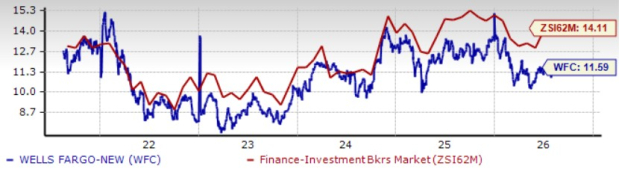
Image Source: Zacks Investment Research
The removal of the asset cap, favorable loan and deposit trends, cost discipline and AI investments provide a solid foundation for earnings and profitability. Further, capital returns and upward earnings estimate revisions strengthen the investment case for WFC.
Overall, Wells Fargo stands out as an attractive investment option for investors seeking exposure to a well-capitalized bank with improving earnings prospects, disciplined capital management and a favorable valuation.
Wells Fargo currently carries a Zacks Rank #2 (Buy). You can see the complete list of today’s Zacks #1 Rank (Strong Buy) stocks here.
Zacks' Research Chief Names "Stock Most Likely to Double"
Our team of experts has just released the 5 stocks with the greatest probability of gaining +100% or more in the coming months. Of those 5, Director of Research Sheraz Mian highlights the one stock set to climb highest.
This top pick is a little-known satellite-based communications firm. Space is projected to become a trillion dollar industry, and this company's customer base is growing fast. Analysts have forecasted a major revenue breakout in 2025. Of course, all our elite picks aren't winners but this one could far surpass earlier Zacks' Stocks Set to Double like Hims & Hers Health, which shot up +209%.
Free: See Our Top Stock And 4 Runners UpWant the latest recommendations from Zacks Investment Research? Today, you can download 7 Best Stocks for the Next 30 Days. Click to get this free report
Wells Fargo & Company (WFC): Free Stock Analysis Report
Bank of America Corporation (BAC): Free Stock Analysis Report
Citigroup Inc. (C): Free Stock Analysis ReportThis article originally published on Zacks Investment Research (zacks.com).
Zacks Investment Research