The Internet-Software & Services industry is currently benefiting from businesses and governments modernizing existing infrastructure while continuing to move existing workflows online and increasing spending on cloud-based technologies. Artificial intelligence is inducing increased technology spending, but its benefits are not equally distributed. While driving demand for automation, infrastructure and cybersecurity solutions, it is greatly adding to uncertainties by disrupting existing business models, commoditizing some offerings and increasing competition. To make matters worse, customer budgets are geared towards expenditure with a quick return on investment. As a result, analyst estimates remain conservative and valuation appears rich.
In this background, Verisign (VRSN) stands out because of its structural advantages that ensure steady, high-margin inflows despite market uncertainties. Donnelley Financial (DFIN) may also be worth keeping an eye on because it has some compelling technology and is migrating to a subscription model with increased customer stickiness.
About the Industry
The Internet Software & Services industry is a relatively small industry primarily involved in enabling platforms, networks, solutions and services for online businesses, including online communication, commerce, data analysis, cybersecurity, collaboration and digital infrastructure, and facilitating customer interaction and use of Internet based services. Most companies operate under Software-as-a-Service (SaaS) or platform models, where customers access applications through web browsers or APIs rather than installing software locally.
Top Themes Driving the Industry
- Cloud adoption is one of the most powerful long-term drivers of the Internet Software & Services industry. Companies are steadily replacing traditional on-premise software — which required local servers, maintenance and large upfront investments — with cloud-based applications delivered over the internet. Cloud platforms allow organizations to scale usage up or down quickly, reduce IT infrastructure costs and deploy software updates automatically without operational disruption. This shift also enables faster innovation, as employees and customers can access systems securely from any location or device. For software providers, cloud delivery transforms revenue from one-time license sales into recurring subscriptions, improving visibility and customer lifetime value. Because migrating systems is complex and costly, customers tend to remain on chosen platforms for years, creating high switching costs and durable revenue streams across the industry.
- The level of technology adoption by businesses impacts growth. Companies continue to build platforms facilitating the development and use of artificial intelligence, scrambling to digitize operations, customer interactions and internal workflows to improve efficiency and competitiveness. This in turn accelerates the adoption of technology that can help collect and analyze data, whether on premise or in the cloud. AI and advanced analytics are becoming embedded in software platforms, enabling automation, predictive decision-making and personalization. Internet software platforms automate processes such as payments, analytics, marketing and compliance, making them essential operating tools rather than optional technology. However, AI is also creating significant uncertainties. It is automating certain processes that were earlier handled with software or personal services, thus disrupting operating models. By facilitating software development, it is also lowering the barriers to entry for some players thus increasing competition. While this is making AI adoption imperative, it is increasing cost. As a result, AI adoption is not having the same effect on all players, making it harder to forecast its impact for the industry as a whole.
- Cybersecurity and Identity Protection are fast-growing segments of the market. As economic activity rapidly moves online, the number of digital identities, transactions and connected systems has also increased with a corresponding increase in exposure to cybercrime and fraud. Businesses now handle sensitive customer data, financial transactions and remote access across cloud environments, making security and identity verification mission-critical rather than optional IT spending. As cyberattacks, account takeovers and synthetic identity fraud become more sophisticated, organizations must invest in software that can continuously monitor users, verify identities, detect suspicious behavior and comply with tightening regulatory requirements. The stricter data protection and compliance standards are forcing companies to adopt specialized security and risk-management platforms. Because these risks evolve constantly, security solutions require ongoing updates and monitoring, driving recurring subscription demand. This creates sustained growth for Internet software providers offering cybersecurity, fraud prevention and identity intelligence tools embedded directly into digital workflows.
- Given the colorful international politics and the resultant volatility in international markets, there is notable impact on the performance of each player. Companies increasingly prefer a subscription-based model, which improves revenue visibility and makes the business less lumpy. Innovation is very important, but not enough to drive growth. This model improves customer retention and allows providers to expand revenue through upgrades, pricing actions and usage growth over time.
Zacks Industry Rank Indicates Deteriorating Prospects
The Zacks Internet – Software & Services industry is housed within the broader Zacks Computer and Technology sector. It carries a Zacks Industry Rank #180, which places it in the bottom 27% of over 245 Zacks-classified industries.
The group’s Zacks Industry Rank, which is basically the average of the Zacks Rank of all the member stocks, indicates that there are some hindrances to growth at the moment. Our research shows that the top 50% of the Zacks-ranked industries outperforms the bottom 50% by a factor of more than 2 to 1.
The aggregate estimate revisions trend is telling. Estimates for fiscal year 2026 have dropped 7.6%, while those for 2027 have dropped 23.9% over the past year. Estimates for both years have moved around quite a bit, with the greatest decline by far coming in September 2025, and then, again in August 2026.
Before we present a few stocks that you may want to consider for your portfolio, let’s take a look at the industry’s recent stock-market performance and valuation picture.
Industry's Stock Market Performance Is Lagging
For most of the past year, the Zacks Internet – Software & Services Industry has traded at a discount to both the broader Zacks Computer and Technology Sector and the S&P 500. While it was more or less level with the others up to November, it has underperformed the others since then.
Overall, the industry returned 20.7% over the past year compared with the broader sector’s return of 31.7% and the S&P 500’s 22.9%.
One-Year Price Performance
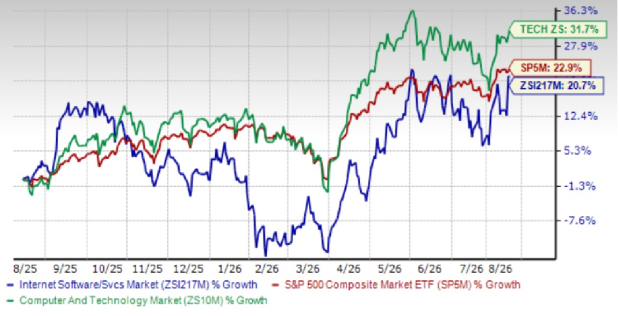
Image Source: Zacks Investment Research
Industry's Valuation is Rich
On the basis of forward 12-month price-to-earnings (P/E) ratio, we see that the industry is currently trading at 26.54X, at a premium to its median level of 23.2X, a 27.5% premium to the S&P 500 and a 22% premium to the broader technology sector. Technology stocks usually trade at a higher multiple because investors pay a higher premium for innovation. The downward revision to earnings estimates appear to be disappointing investors.
The industry has traded in the range of 20.36X to 29.73X over the past year, as the chart below shows.
Forward 12 Month Price-to-Earnings (P/E) Ratio

Image Source: Zacks Investment Research
2 Stocks Worth Considering
Verisign, Inc. (VRSN): Reston, VA-based VeriSign provides Internet infrastructure services, exclusively operating the domain name registries for .com and .net under agreements with ICANN. The company builds and maintains highly specialized domain name system (DNS) infrastructure that handles massive volumes of queries while maintaining high reliability and resilience against cyberattacks, outages and other technological disruptions.
The company enjoys a monopoly-like position for the .com and .net registries, the combined volumes of which rose 5.1% to 179.1 million in the last quarter. Continued Internet adoption and businesses’ preference for the .com domain support continued growth in the installed base and generate steady recurring revenue. The huge installed base and supporting infrastructure create a competitive moat because would be difficult for a competitor to simultaneously build the necessary infrastructure, secure the required regulatory agreements and also persuade businesses to switch from established .com domains, which are often integral to their brand identity and online presence. Verisign enjoys very strong renewal rates, exceeding 76% in the last quarter, despite price increases. It is contractually permitted to increase the wholesale prices it charges registrars by up to 7% in four of the six years of the current .com contract that expires in 2030 (up to 10% every year for the current .net contract expiring in 2029). The business also scales profitably, with 67% of the revenue generated falling through to the operating profit line while its capital-light model allows it to expand the domain base without requiring significant incremental investment. Therefore, the company generates very solid cash flow.
While the business is very attractive right now, it’s worth noting that the .com base is mature, making sustained growth increasingly dependent on domain renewals, new registrations and contractual price increases. New businesses have a growing number of alternatives, including other TLDs like .ai and .shop, country-code domains as well as alternative ways of establishing an online presence such as through platforms like Shopify, social commerce platforms and apps. The company's competitive moat is also partly dependent on its regulatory and contractual dependencies on ICANN and the U.S. government, which could become less favorable when these agreements are renegotiated or renewed.
Shares of this Zacks Rank #2 (Buy) company have gained 5.8% over the past year. Verisign’s earnings for the June quarter beat the Zacks Consensus Estimate by 0.9% and the preceding four quarter average surprise was 1.5%. The Zacks Consensus Estimate for 2026 has increased 9 cents to $9.56 in the last 30 days while that for 2027 increased 50 cents to $10.71. Analysts currently expect 2026 revenue and earnings to grow a respective 5.9% and 8.5%. Estimates for the following year are currently expected to grow 8.7% and 12%.
Price and Consensus: VRSN

Image Source: Zacks Investment Research
Donnelley Financial Solutions (DFIN): Lancaster, PA-based Donnelley is a financial technology and compliance software company that helps public companies, investment firms and capital market participants manage regulatory reporting and investor communications. Originally a financial-printing business spun off from R.R. Donnelley, DFIN is transforming into a cloud-software provider focused on automating complex disclosure, compliance and transaction workflows.
Its most Important Products (in order of importance) are
- ·ActiveDisclosure — A cloud platform for creating and filing SEC and financial reports; core recurring revenue engine and highest customer stickiness.
- Venue — Virtual data room software used for IPOs and M&A due diligence; drives growth during strong deal markets.
- ·Arc Suite — Compliance and reporting platform for investment managers and funds; provides steady, regulation-driven subscription revenue.
- eBrevia — AI contract-analysis tool that automates legal document review; enhances deal workflows and future AI expansion potential.
Software revenue continues to grow strongly toward the management-targeted 60% mix by 2028. The recurring, subscriptions-based software revenue is expected to generate higher margins and more predictable cash flow. Increasing regulatory complexity and reporting requirements across the world is a structural tailwind, as compliance is mandatory and there is reluctance to switch vendors once regulatory workflows are embedded. Historically, deal activity (IPOs, M&A) has been cyclical and the company has benefited from stronger capital market activity. Therefore, under the current revenue model, software is adding stable recurring revenue at attractive margins, transactional revenue is adding volume, while the legacy business provides cash flow and customer relationships that support the transition toward higher-value software. Significant operating leverage, along with higher software revenue, should allow margins to expand at a higher rate than revenue growth. Share buybacks provide liquidity to investors and boost the EPS.
On the downside, the software transition carries significant execution risk. How the company manages this is a big question considering that software growth has moderated in recent quarters and the software mix is currently at around 44%, meaning that there is still some way to go to reach the 60% target. As regards product performance, ActiveDisclosure has maintained consistently strong growth while Venue has not really done that well. Despite the growing software mix, quarterly revenues and margins can still fluctuate significantly with increases or decreases in deal activity. Additionally, the market is fragmented, with relatively low barriers to entry; and technology-enabled, AI-powered and self-filing solutions add to the competition.
The shares appear significantly undervalued compared to the broader industry and also the S&P 500. This may create an opportunity if execution improves.
Shares of this Zacks Rank #3 (Hold) company have lost 17.7% over the past year. The company posted a positive surprise of 6.7% in the last quarter, taking the four-quarter average surprise to 31.7%. The Zacks Consensus Estimate for 2026 remains unchanged in the last 30 days. The 2027 earnings estimate increased 10 cents to $5.40. Revenues are expected to increase 2.4% this year with earnings growing 15.1%. Earnings are currently expected to grow 11.1% the following year on the back of 2.9% revenue growth.
Price and Consensus: DFIN

Image Source: Zacks Investment Research
7 Best Stocks for the Next 30 Days
Just released: Experts distill 7 elite stocks from the current list of 220 Zacks Rank #1 Strong Buys. They deem these tickers "Most Likely for Early Price Pops."
Since 1988, the full list has beaten the market more than 2X over with an average gain of +23.9% per year. So be sure to give these hand picked 7 your immediate attention.
See them now >>Want the latest recommendations from Zacks Investment Research? Today, you can download 7 Best Stocks for the Next 30 Days. Click to get this free report
VeriSign, Inc. (VRSN): Free Stock Analysis Report
Donnelley Financial Solutions (DFIN): Free Stock Analysis ReportThis article originally published on Zacks Investment Research (zacks.com).
Zacks Investment Research