The digital payments industry is expanding beyond traditional card transactions as consumers increasingly adopt mobile payments, real-time money movement and flexible financing options. At the same time, emerging technologies such as artificial intelligence are reshaping how transactions are initiated, processed and secured, creating new growth opportunities across the payments ecosystem.
Visa Inc. V and Affirm Holdings, Inc. AFRM offer distinct ways to participate in this growth. Visa operates a global payments network and is expanding into areas such as real-time money movement, installments and AI-enabled commerce, while Affirm is focused more directly on consumer financing and pay-over-time solutions. Affirm is also broadening its reach through partnerships that embed its BNPL capabilities into debit-card programs, including a 2026 collaboration with Fiserv. These differences in business models, growth drivers and exposure to consumer spending make the stocks worth comparing from a fundamental and strategic perspective.
Let’s dive deep and closely compare the fundamentals of the two stocks to determine which stock offers greater upside right now.
The Case for Visa
Visa’s growth story continues to rest on a broadening payments ecosystem rather than a single volume driver. In the third quarter of fiscal 2026, payments volume rose 10% year over year in constant dollars, and processed transactions increased 10% to 71.7 billion. Cross-border volume, excluding intra-Europe transactions, climbed 12%, with cross-border e-commerce advancing 16%, providing another strong contributor as travel and digital commerce remain healthy.
Value-added services (VAS) are becoming an increasingly important layer of Visa’s growth beyond its core payment network. VAS revenues jumped 34% year over year in constant dollars in the fiscal third quarter, with revenue growth across Issuing, Acceptance, and Risk and Security solutions staying above 20% in the past year.
Visa beat earnings in each of the past four quarters with an average surprise of 2.8%.
The company is also expanding its presence in buy now, pay later (BNPL), with Visa Installments providing issuers and fintechs with flexible financing capabilities that can be integrated into the checkout experience. Installment payments become a more established part of digital commerce, which creates another avenue for V to monetize its network.
The company is also positioning its infrastructure for the next phase of digital commerce. The Visa Stablecoin Platform is being built to support stablecoin minting, movement and management, while its integration with Pismo could support tokenized deposits. On the front end, V is developing agentic-commerce capabilities and has partnered with OpenAI to enable secure payments in AI-driven transactions. More than 150 AI-powered applications are already in use, and Visa has shipped more than 300 major product releases over the past year.
However, escalating operating expenses and higher rebates and client incentives will likely impact its growth potential. In the third quarter of fiscal 2026, V’s adjusted operating expenses rose 17% year over year. In the United States, the Department of Justice earlier accused the company of using its dominance to overcharge merchants. European and U.K. regulators are also investigating cross-border and merchant fees, potentially leading to fee caps or new compliance requirements, which could dent revenue growth in the region.
The Case for Affirm
Affirm’s core BNPL business continues to expand as merchant adoption and consumer demand support higher transaction volumes. Active merchant count increased 44% year over year in the third quarter of fiscal 2026, with large payment service providers and platforms such as Shopify continuing to add merchants to the network. Pay in X has also become the company’s fastest-growing segment, supported by Shopify and a major program that shifted to an evergreen 0% Pay in 4 offering, a trend expected to continue into fourth-quarter fiscal 2026.
Gross Merchandise Volume (GMV) continues to provide a strong foundation for the company’s growth. The momentum was broad-based, with transactions surging 45% year over year to 45.3 million in the third quarter of fiscal 2026 and active consumers growing 22% to 26.8 million. Transactions per active consumer also increased 20% to 6.7, suggesting that growth is coming not only from a larger user base but also from deeper engagement. Meanwhile, cardholders count reached 4.4 million, while the product remains the company’s fastest-growing and most profitable offering. It beat earnings in each of the past four quarters with an average surprise of 74.9%.
Affirm is also expanding beyond traditional BNPL through technology that helps merchants optimize financing offers and improve conversion. Its AI-driven tools can tailor financing programs to consumer and merchant needs, potentially increasing GMV while strengthening Affirm’s value proposition at checkout.
Lower funding costs and international expansion add further upside to the longer-term story. Affirm’s funding costs declined about 125 basis points year over year in the third quarter of fiscal 2026 as ABS deals continued to attract strong demand and spreads tightened. At the same time, preparations for international launches are already underway, with additional investment planned as new markets come online.
However, it continues to face a rise in total expenses. Total operating expenses rose 20.1% year over year in the fiscal third quarter. Affirm’s funding model relies on securitizations, warehouse facilities and other debt funding, which keeps balance sheet leverage elevated. Its long-term debt-to-capital of 70.5% is higher than V’s 37.2% and the industry’s average of 19.4%.
How Do Estimates Compare for V & AFRM?
The Zacks Consensus Estimate for Affirm's bottom line is comparably favorable at this stage. The consensus estimate for V’s fiscal 2026 earnings indicates an 11.5% increase from a year ago, while the same for revenues suggests 14.6% growth. On the other hand, the Zacks Consensus Estimate for Affirm's fiscal 2026 EPS indicates a 726.7% year-over-year improvement, and the same for revenues signals a 30.5% rise.
Price Performance Comparison
Over the past three months, Visa’s shares have underperformed compared with AFRM. Meanwhile, the S&P 500 increased 2.3% during this time.
Price Performance – V, AFRM & S&P 500
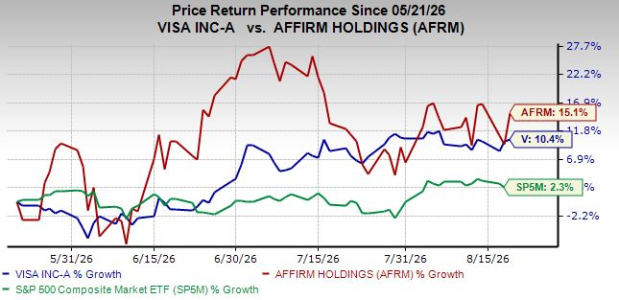
Image Source: Zacks Investment Research
Valuation: V vs. AFRM
On a price-to-sales basis, Visa sits at 13.04X forward revenues, significantly above Affirm’s multiple of 4.69X. AFRM’s cheaper P/S multiple leaves room for significant growth as business expansion accelerates.

Image Source: Zacks Investment Research
Price Target
Visa currently trades below its average analyst price target of $418.18, implying a 14.4% potential upside from current levels. AFRM also trades below its average analyst price target of $93.50, implying an attractive 20.9% potential upside from current levels.
Conclusion
Visa and Affirm both offer compelling exposure to the continued evolution of digital payments, but their upside comes from different sources. Visa benefits from a highly scaled global network, resilient payment volumes, strong Value-Added Services growth and emerging opportunities in AI, stablecoins and agentic commerce. Affirm, meanwhile, is growing at a faster pace, supported by expanding BNPL adoption, rising GMV, a broader merchant network and increasing use of its Card.
AFRM’s stronger growth profile, expanding ecosystem and lower valuation multiple offer greater upside potential. For investors seeking rapid future gains rather than stability, Affirm appears to have the edge at this stage of the cycle, even though both companies currently carry a Zacks Rank #3 (Hold).
You can see the complete list of today’s Zacks #1 Rank (Strong Buy) stocks here.
7 Best Stocks for the Next 30 Days
Just released: Experts distill 7 elite stocks from the current list of 220 Zacks Rank #1 Strong Buys. They deem these tickers "Most Likely for Early Price Pops."
Since 1988, the full list has beaten the market more than 2X over with an average gain of +23.9% per year. So be sure to give these hand picked 7 your immediate attention.
See them now >>Want the latest recommendations from Zacks Investment Research? Today, you can download 7 Best Stocks for the Next 30 Days. Click to get this free report
Visa Inc. (V): Free Stock Analysis Report
Affirm Holdings, Inc. (AFRM): Free Stock Analysis ReportThis article originally published on Zacks Investment Research (zacks.com).
Zacks Investment Research