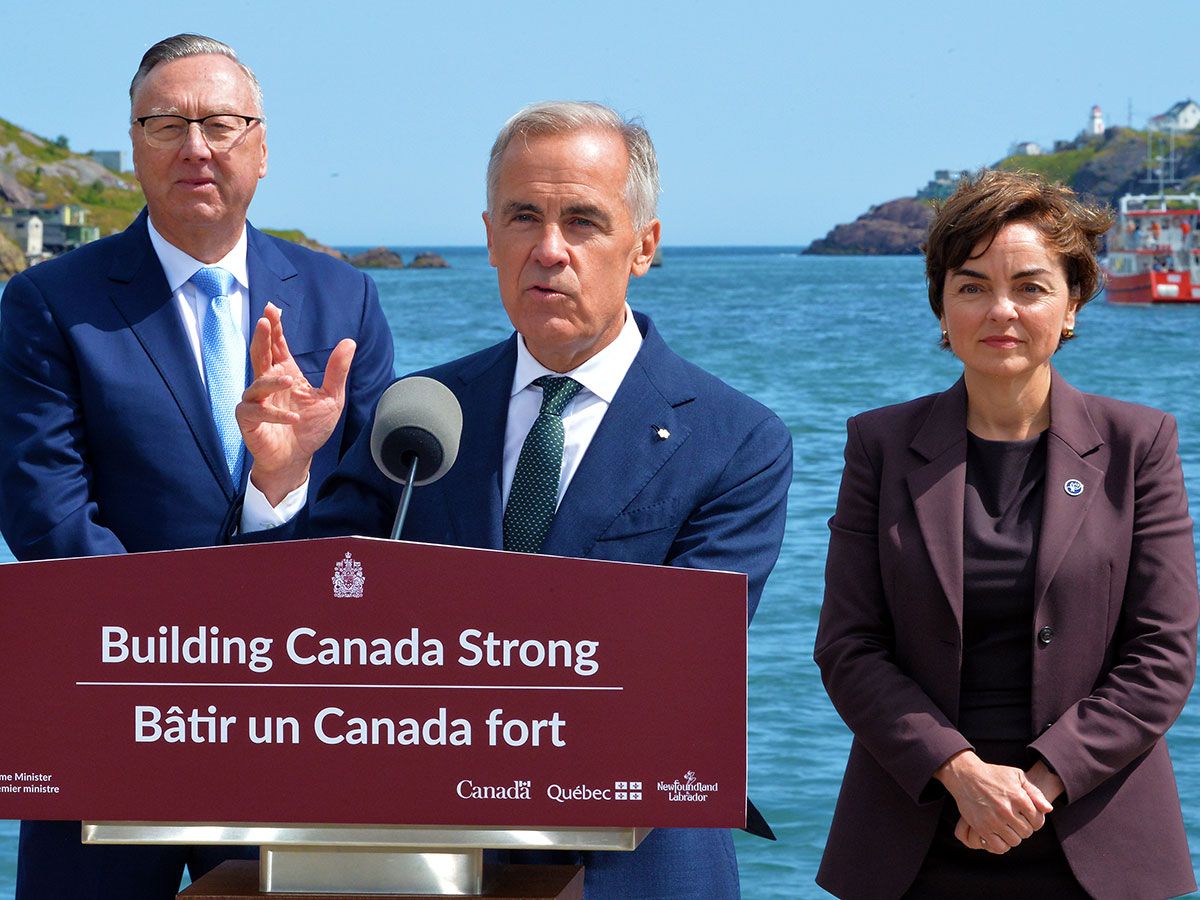
The federal government’s agreement this week to provide up to $10 billion in financial support for the Gull Island hydroelectric project is notable for more than its size. It also offers a glimpse of how the Carney government’s broader economic agenda will have to be financed.
For decades, federal governments have relied on a familiar model to advance national economic priorities: Ottawa puts money on the table and uses that funding to leverage additional investment and action from provinces.
But that model depends on provinces having the fiscal capacity to come along.
The Carney government is pursuing an unusually ambitious agenda, with plans to mobilize hundreds of billions of dollars in investment in infrastructure, energy, housing, defence and other areas. At the same time, provincial finances are becoming increasingly constrained.
That combination could force a significant change in the traditional federal-provincial bargain. Ottawa may have to assume a larger share of the cost and financial risk of Canada’s growth agenda rather than relying as heavily on provincial governments to match its ambitions.
There are signs that shift is already underway.
In Newfoundland and Labrador, Ottawa has committed up to $10 billion in financial support tied to the redevelopment and expansion of Churchill Falls , the Gull Island hydroelectric project and associated transmission infrastructure.
British Columbia’s recent agreement with Ottawa also illustrates the shift. The federal government has committed billions toward major transportation, energy and economic-development projects, while B.C. will contribute to workforce training and childcare investments. Instead of relying on the province to shoulder a proportional share of project financing, Ottawa is assuming a larger role in providing upfront capital, helping advance national priorities amid growing provincial budget pressures.
Quebec’s pre-election fiscal update, released this week ahead of the provincial campaign, offers a clear illustration of the emerging provincial constraints. Returning to balance depends on significant spending restraint and economic assumptions that leave little room for disappointment. With population growth expected to remain weak, the province is counting on strong per-capita economic growth, while warning that a tariff-driven recession could erase almost $11 billion in revenue over five years.
Yet, that challenge is hardly unique to Quebec. All of Canada’s provinces face budget deficits, rising health-care costs, aging populations, infrastructure backlogs and pressure to improve competitiveness.
These constraints matter because Canada’s federal economic agenda is becoming more dependent on provincial participation.
Ottawa can provide funding and set priorities, but implementation often rests with provinces and territories, which control many of the regulatory, permitting and infrastructure decisions required to turn federal ambitions into economic outcomes.
Housing is a clear example. Federal programs can encourage construction, but provinces and municipalities remain responsible for much of the infrastructure and planning needed to support growth.
The same dynamic applies to critical minerals, electricity transmission, trade-enabling infrastructure and defence-related industrial investments. In each case, ambitious national objectives depend on provincial governments’ ability to contribute financially and move projects forward.
Yet Canada’s policy debate often assumes that provincial participation will simply materialize once Ottawa announces a priority and commits funding. Increasingly, that assumption looks questionable.
The solution is not simply larger transfers. More operating funding does not necessarily make a transmission line, housing development, mine or trade corridor easier to finance or execute. Instead, Ottawa may need to rely more heavily on loans, equity investments and other financing structures that reduce pressure on provincial operating budgets while still advancing national priorities.
Ottawa also has tools that are not available to most provinces. Institutions such as Export Development Canada, the Business Development Bank of Canada, the Canada Infrastructure Bank and the Canada Mortgage and Housing Corporation have expertise in project finance, lending and risk management that could be deployed more aggressively to advance major national objectives.
Increasingly, Canada’s growth agenda will depend on Ottawa assuming responsibilities that might once have fallen to the provinces. The federal government benefits from deeper capital markets, broader access to investors, stronger credit quality and generally lower borrowing costs than most provincial governments. It can often finance long-term investments more efficiently and absorb risks that provinces and territories may be unwilling or unable to take.
The central challenge for Ottawa is no longer identifying growth opportunities. It is finding provincial partners with the fiscal capacity to seize them. If recent agreements in B.C. and Newfoundland and Labrador are any indication, the federal government’s answer is becoming clear: absorb more of the risk, provide more of the capital and play a larger role in financing Canada’s economic future.
Marc Desormeaux is an economist and vice-president of policy at the Business Council of Canada