The AI boom is creating opportunities across the entire data-center stack. While companies such as Advanced Micro Devices AMD are competing for a larger share of AI computing through advanced accelerators, Seagate Technology Holdings Plc STX is targeting another critical part of the infrastructure - the massive storage capacity required to collect, train, operate and preserve AI-generated data.
Per a report from Fortune Business Insights, the global AI infrastructure market is estimated to grow from $75.4 billion in 2026 to $497.98 billion by 2034, representing a CAGR of 26.6%. This makes both STX and AMD intriguing AI infrastructure bets, but they represent fundamentally different investment theses. AMD is positioned closer to the computational side of AI, while Seagate benefits from the enormous data storage requirements driven by AI expansion.
So, which has the edge? Let’s find out.
The Case for STX Stock
Seagate delivered strong fiscal 2026 performance, with momentum building each quarter and expected to continue into fiscal 2027. STX’s growth outlook remains supported by strong demand for mass-capacity storage, particularly from cloud and AI applications. In fiscal 2026, revenue grew 34%, while cloud data centers accounted for roughly 90% of exabyte shipments, with customer commitments extending into 2028 and beyond. Rising data creation, retention and utilization across hyperscalers, Neoclouds and edge applications are expected to sustain long-term storage demand.
Emerging AI workloads, including KV caches, robotics and autonomous vehicles, could further increase storage requirements as unstructured data continues to grow. Technology innovation remains central to Seagate’s strategy. It is accelerating its transition to HAMR, which already represented 40% of nearline exabytes sold by June, intending to reach 70% by June 2027. Its Mozaic platform is also advancing drive capacities, with Mozaic 4 ramping and Mozaic 5 expected in late 2027. Seagate is investing in manufacturing tools, yield improvements and capacity expansion to support these transitions and capture growing exabyte demand.
While product changes increase factory complexity and require additional tool time, the company expects areal-density gains to meet future demand without relying heavily on additional manufacturing capacity. Strong demand is also supporting Seagate’s value-based pricing strategy. Recent quarters benefited from higher-than-expected pricing, while ongoing customer negotiations could provide further pricing opportunities, although future gains will depend on supply-demand conditions. Favorable terms from early HAMR customers are expected to phase out over time, but improving margins and incremental gross margins above 60% point to continued profitability gains.
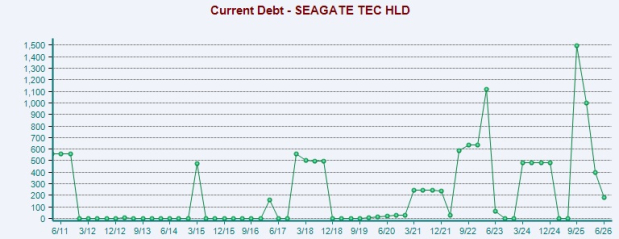
Image Source: Zacks Investment Research
Financial discipline remains another strength. Seagate has reduced debt from $5 billion to $2.4 billion while continuing share buybacks and maintaining CapEx at roughly 4-6% of revenue. Combined with strong demand, differentiated technology, disciplined execution and an expanding HAMR portfolio, these initiatives position STX to capitalize on the long-term growth in AI, cloud and data-intensive storage. However, Seagate faces execution risks from its HAMR transition, manufacturing complexity and potential yield issues. Heavy reliance on cloud customers also creates concentration and spending-cycle risks. Competition is intense, while tariffs, trade restrictions, FX volatility and macroeconomic uncertainty could affect results.
The Case for AMD Stock
AMD is benefiting from strong AI and data-center demand, with record revenue growth and data-center sales more than doubling. Its expanding EPYC CPU portfolio, next-generation Venice processors and Helios AI platform are strengthening its position across servers and AI infrastructure. Growing adoption among major hyperscalers and AI customers, alongside partnerships such as Anthropic, supports further market-share gains. AMD also expects to outgrow the broader AI market, with revenue growth targeted well above 40% CAGR through 2030.
Helios is in production, with initial shipments expected late in the third quarter and a larger ramp in the fourth quarter and 2027. Anthropic plans to deploy up to 2 GW of MI450-series GPUs, with the first GW beginning in the first half of 2027, while Microsoft plans to deploy Helios at scale on Azure. Management expects Data Center segment revenue to more than double year over year in 2027. Sixth-generation EPYC Venice is now in production on 2-nanometer technology, and major OEMs are preparing platforms while leading cloud providers plan deployments later in 2026. Management now expects server revenue to grow more than 80% year over year in the second half of 2026 and more than 70% in 2027, while estimating the server CPU market at about $220 billion by 2030.

Image Source: Zacks Investment Research
However, AMD faces supply constraints as it ramps advanced 2nm products, while manufacturing, packaging and substrate capacity remain key execution factors. The company also operates in a highly competitive AI market, requiring continued heavy R&D investment and frequent product launches. Rising data-center AI exposure could create margin pressure during the initial ramp, while customer deployment schedules and broader AI infrastructure spending remain potential risks.
AMD also competes against accelerator and CPU vendors while scaling a more complex rack-level AI offering. Helios is designed to improve inference economics, but management said data center AI gross margin is slightly below the corporate average. The mix can therefore limit gross-margin expansion as Helios revenue grows, even as higher-margin server CPUs and Embedded products provide offsets.
Price Performance for STX & AMD
Over the past year, STX and AMD have gained 434% and 179.8%, respectively, compared with the Zacks Computer Integrated Systems industry’s growth of 204%.

Image Source: Zacks Investment Research
Valuation: Premium vs. Discount

Image Source: Zacks Investment Research
STX looks more attractive than AMD from a valuation standpoint. Going by the price/earnings ratio, AMD’s shares currently trade at 42.96 forward earnings, way more than 22.54 for STX.
How Do Zacks Estimates Compare for STX & AMD?
STX is currently witnessing an uptrend in estimate revisions. Earnings estimates for fiscal 2027 have been revised up 26.2% to $34.99 over the past 60 days, while estimates for fiscal 2028 have risen 12.9% to $55.85.
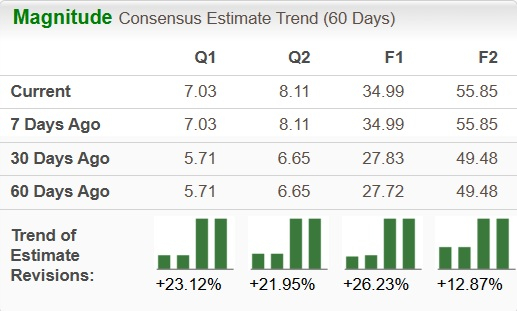
Image Source: Zacks Investment Research
The Zacks Consensus Estimate for AMD’s earnings for both fiscal 2026 and 2027 has been revised upward over the past 60 days.

Image Source: Zacks Investment Research
STX or AMD: Which AI Infrastructure Bet Has the Edge?
Seagate and AMD offer different ways to play the AI infrastructure boom. Seagate benefits from surging demand for mass-capacity storage as AI drives data creation and retention, with HAMR technology and strong pricing supporting growth. AMD offers the higher-growth AI compute opportunity, with expanding EPYC and Instinct platforms, growing hyperscaler adoption and a broader AI ecosystem. Seagate provides a more focused bet on the storage layer, while AMD has greater exposure to the expanding AI compute market.
For investors looking for a beneficiary of AI infrastructure spending, Seagate deserves serious consideration. Its recent financial performance demonstrates that AI demand is already reaching the storage layer, while its HAMR roadmap could allow it to monetize continued growth in data volumes. STX at present boasts a Zacks Rank #1 (Strong Buy), while AMD has a Zacks Rank #3 (Hold). Consequently, in terms of Zacks Rank and valuation, STX may offer a more focused bet on the expanding data layer of AI infrastructure. You can see the complete list of today’s Zacks #1 Rank stocks here.
Beyond Nvidia: AI's Second Wave Is Here
The AI revolution has already minted millionaires. But the stocks everyone knows about aren't likely to keep delivering the biggest profits. AI’s second wave is moving from infrastructure to implementation and these companies are at the forefront of this transition, positioned to become what Amazon and Google were to the internet era.
See Stocks Now >>Want the latest recommendations from Zacks Investment Research? Today, you can download 7 Best Stocks for the Next 30 Days. Click to get this free report
Advanced Micro Devices, Inc. (AMD): Free Stock Analysis Report
Seagate Technology Holdings PLC (STX): Free Stock Analysis ReportThis article originally published on Zacks Investment Research (zacks.com).
Zacks Investment Research