The quantum-computing trade has entered a more demanding phase in the second half of 2026. After a powerful rally earlier this year, investors are increasingly looking beyond qubit milestones and government support toward revenue visibility, cash requirements and commercialization. This shift comes as the macro backdrop becomes less favorable for high-risk growth stocks within the quantum computing space.
Against this backdrop, two pure-play quantum computing stocks outside the sector's leading names that are showing notable commercial momentum are Quantum Computing Inc. QUBT or QCi and Quantinuum Inc. QNT. Let’s delve deeper.
A Cooling Labor Market
The Federal Reserve kept the federal funds target range at 3.5%-3.75% at its July 29 meeting, while inflation remains elevated. Going by the BLS’ July CPI report, released in August 2026, the July Consumer Price Index (CPI) rose 3.4% year over year, with core CPI up 2.5%, while the energy index increased 14.7% for the 12 months ending July. The labor market is also cooling. July nonfarm payrolls declined 23,000, with unemployment at 4.1%, according to the BLS’ August-released Employment Situation Summary report.
Higher Yields, Persistent Inflation and Fiscal Risks Add Pressure
The macro backdrop is becoming less forgiving for long-duration, speculative technology stocks. The BEA's latest Personal Income and Outlays report showed the personal consumption expenditures (PCE) price index rising 3.7% year over year in June, while core PCE increased 3.3%. Although the headline PCE index fell 0.1% month over month, underlying inflation remains well above the Federal Reserve's 2% target, limiting the scope for rapid monetary easing.
Producer-price pressures add to the challenge. July Producer Price Index (PPI) rose 4.7% year over year, although the index was unchanged month over month. Prices excluding food, energy and trade services also rose 4.7% over the 12 months ended in July, suggesting that cost pressures remain elevated.
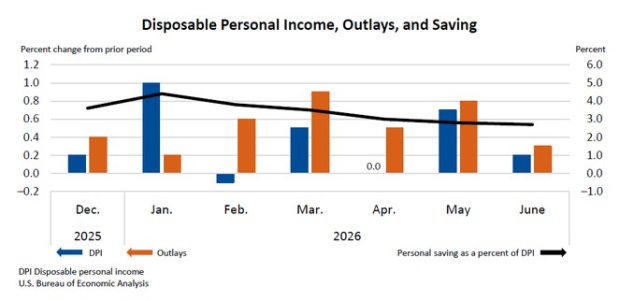
Image Source: The U.S. Bureau of Economic Analysis (BEA)
At the same time, real consumer spending increased 0.4% in June, according to the BEA, indicating that the U.S. economy still has an important source of resilience. That makes the backdrop less about an outright economic downturn and more about persistent inflation, elevated borrowing costs and a higher hurdle for speculative investments.
The bond market is adding another layer of pressure. Reuters reported on Aug. 21 that U.S. long-term yields remained elevated, with the 30-year Treasury yield around 5.25%, as investors weighed inflation, fiscal deficits and a U.S. debt load that has surpassed $40 trillion. Oil prices also climbed amid renewed Middle East tensions, increasing the risk that energy inflation could complicate the Fed's policy path.
For quantum stocks, the message is increasingly clear- technological promise alone is no longer enough. Investors want evidence that bookings, partnerships and technical milestones can translate into scalable commercial revenue.
Why IONQ and QBTS Are Under Pressure
The pressure on prime-line pureplay quantum stocks like IonQ IONQ and D-Wave Quantum QBTS is therefore not necessarily a rejection of quantum technology. It reflects the widening gap between ambitious long-term opportunities and near-term financial execution. IonQ delivered an impressive 287% year-over-year increase in its second-quarter revenues and raised its 2026 revenue outlook to $280-$290 million. However, its valuation remains lumpy, while the company continues to invest heavily in expansion and integration following the SkyWater acquisition. IONQ currently has a Zacks Rank #4 (Sell).
D-Wave faces a different challenge. First-half bookings surged 1,120% year over year, but second-quarter revenue was only $3.1 million, essentially flat from a year earlier. The disparity shows the sector's key bottleneck- turning bookings, pilots and technical advances into recurring revenue at scale. QBTS also carries a Zacks Rank #4 right now.
Government Support is Strong - But Commercialization Still Matters
Washington continues to support the strategic development of quantum computing. A June 22 White House executive order called for a national effort to develop a powerful quantum computer and accelerate quantum capabilities for commercial applications. The Department of Energy subsequently launched its Quantum Genesis initiative targeting scientifically relevant, fault-tolerant quantum computers.
These initiatives strengthen the industry's long-term opportunity, but government support does not eliminate execution risk. Quantum companies still face hardware-scaling, error-correction, manufacturing, data-preparation and customer-adoption bottlenecks.
QUBT: Diversification Creates a Different Growth Profile
Quantum Computing or QCi’s second-quarter 2026 revenues jumped to $5.6 million from $61,000 a year earlier, while contract backlog reached approximately $42.5 million. The company also completed its NHanced Semiconductors acquisition and delivered its Dirac-3 quantum optimization system to a global consulting firm. Importantly, QUBT is building exposure across quantum photonics, semiconductors and quantum optimization rather than relying on a single hardware pathway.
The stock currently carries a Zacks Rank #3 (Hold). Based on short-term price targets offered by six analysts, the average price target for QCi comes to $18.33, representing an increase of 125.2% from the last closing price of $8.14.

Image Source: Zacks Investment Research
QNT: Commercial Momentum Is Accelerating
Quantinuum offers another differentiated route into quantum computing, with an enterprise-focused full-stack model spanning hardware, software and applications. Its second quarter revenue increased 279% year over year, while the company raised its 2026 revenue outlook to $28-$32 million and reported year-to-date bookings of $81 million. Its Helios system also demonstrated near-five-nines logical fidelity, strengthening its technology proposition. Quantinuum's planned integration with Oracle Cloud Infrastructure provides another potential avenue for enterprise adoption. With more than $2 billion of cash, cash equivalents and short-term investments after its IPO, QNT has substantial resources to fund development. Its key risk remains valuation and the long path to profitability.
The stock also carries a Zacks Rank #3. Based on short-term price targets offered by 12 analysts, the average price target for Quantinuum comes to $97.17, representing an increase of 77% from the last closing price of $54.90. You can see the complete list of today’s Zacks #1 Rank (Strong Buy) stocks here.

Image Source: Zacks Investment Research
Beyond Nvidia: AI's Second Wave Is Here
The AI revolution has already minted millionaires. But the stocks everyone knows about aren't likely to keep delivering the biggest profits. AI’s second wave is moving from infrastructure to implementation and these companies are at the forefront of this transition, positioned to become what Amazon and Google were to the internet era.
See Stocks Now >>Want the latest recommendations from Zacks Investment Research? Today, you can download 7 Best Stocks for the Next 30 Days. Click to get this free report
Quantum Computing Inc. (QUBT): Free Stock Analysis Report
Quantinuum Inc. (QNT): Free Stock Analysis Report
IonQ, Inc. (IONQ): Free Stock Analysis Report
D-Wave Quantum Inc. (QBTS): Free Stock Analysis ReportThis article originally published on Zacks Investment Research (zacks.com).
Zacks Investment Research