Chevron Corporation CVX and Shell plc SHEL are two of the world’s largest integrated energy companies, with exposure to upstream production, refining, natural gas, LNG and emerging energy opportunities. Both are using portfolio high-grading, cost reductions and disciplined capital allocation to strengthen returns. That makes the comparison relevant for investors seeking scale, cash generation and long-term energy growth.
Despite operating in the same sector, the key difference is where future growth is coming from. Chevron is leaning on the Hess acquisition, Guyana, the Permian Basin and new power opportunities, while Shell is sharpening its portfolio around LNG, advantaged upstream assets and the pending ARC Resources acquisition. Let’s dive deep and closely compare the fundamentals of the two energy giants to determine which offers a better bet.
The Case for Chevron Stock
Chevron enters the comparison with a powerful upstream growth platform. Its 2026 production guidance stands at 3.98-4.10 million barrels of oil equivalent per day, representing 7%-10% growth excluding asset sales. The Hess combination has materially expanded Chevron’s portfolio, particularly in Guyana and the Bakken. Management says Guyana can support high-margin oil growth into the 2030s, while the Stabroek Block is expected to have eight FPSOs and roughly 1.7 million gross barrels per day of capacity by 2030.
Execution has strengthened the investment case. Chevron achieved $3 billion of annual run-rate structural cost reductions six months ahead of schedule and realized $1.5 billion of annual Hess synergies, 50% above its original target. The company also expects 2026 shale and tight capital spending per barrel to be 25% lower than last year. These gains can improve free-cash-flow resilience while production expands.
Chevron is also opening a new avenue beyond traditional oil and gas. Project Kilby is backed by a 20-year take-or-pay power purchase agreement with Microsoft for 2.67 gigawatts of behind-the-meter power in West Texas. Management expects mid-teens returns and long-duration contracted cash flows that are less exposed to commodity cycles. Meanwhile, the Angola Block 0 discovery adds another potential capital-efficient development opportunity near existing infrastructure.
The risks remain meaningful. Chevron is highly sensitive to oil and gas prices, and its 2026 earnings and cash flow are estimated to move by roughly $600 million for every $1 change in Brent. The company also faces execution risk around Hess integration, large developments, geopolitical exposure in Venezuela, Kazakhstan and the Middle East, and planned third-quarter maintenance downtime. Still, its broad asset base and stronger balance sheet provide protection.
The Case for Shell Stock
Shell’s biggest strength is its integrated gas and LNG business. The first phase of LNG Canada has reached full capacity after shipping more than 100 cargoes since startup, while Shell’s global LNG trading and optimization capabilities allow it to capture value across changing market conditions. Its integrated model also connects upstream, refining, chemicals, marketing and trading, giving the company flexibility to optimize products and margins across the value chain.
The pending ARC Resources acquisition could significantly improve Shell’s medium-term growth profile. The $16.4 billion transaction is expected to increase combined Integrated Gas and Upstream production growth to about 4% annually through 2030 from 2025 levels. ARC also deepens Shell’s position in Canada’s Montney Basin and is expected to contribute around $1.5 billion of average annual free cash flow. Shell is simultaneously high-grading its portfolio through asset sales.
Capital discipline is another positive. Shell has achieved $5.8 billion of structural cost reductions since 2022 and targets $5-$7 billion by the end of 2028. It plans to distribute 40%-50% of cash flow from operations through the cycle, maintains a progressive dividend policy and has continued sizable buybacks. Cash capital spending is expected at $24-$26 billion in 2026 before falling to $20-$22 billion annually in 2027-2028.
However, Shell has more visible near-term operational disruption. Middle East exposure is concentrated in Qatar, where LNG production was shut in, and Pearl GTL Train Two repairs are expected to continue into first-quarter 2027. The ARC deal still requires successful completion and integration, while commodity prices, trading conditions, refining margins and energy-transition regulation remain uncertain.
Price Performance
In the past year, shares of CVX and SHEL have gained 29.8% and 26.5%, respectively.

Image Source: Zacks Investment Research
Valuation Comparison
From a valuation perspective — in terms of forward price-to-sales ratio — Chevron is trading at a premium of 1.84X compared with Shell’s 0.73X.
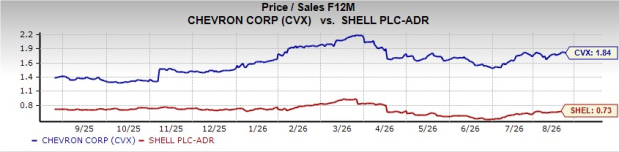
Image Source: Zacks Investment Research
Earnings Estimate Trend
According to the Zacks Consensus Estimate, CVX’s earnings are set to rise 121.8% in 2026.

Image Source: Zacks Investment Research
The same for SHEL’s 2026 EPS indicates a year-over-year increase of 64.4%.
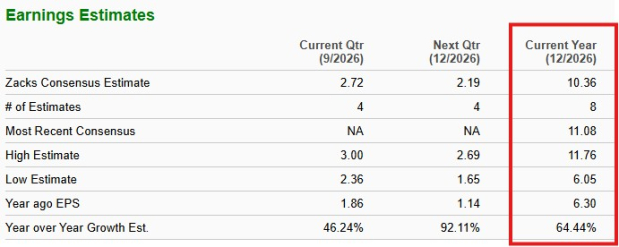
Image Source: Zacks Investment Research
Conclusion
Chevron and Shell maintain strong future growth prospects, supported by high-grade portfolios, cost reduction strategies and disciplined capital allocation, which strengthen their returns, justifying Zacks Rank #3 (Hold) for both companies.
Shell offers investors a more discounted valuation and continues to benefit from an attractive LNG business, disciplined distributions and stronger growth after the ARC Resources acquisition. However, its investment case remains tempered by Middle East exposure and integration risks.
Chevron appears better positioned overall due to its clearer near-term production momentum, faster realized synergies, deeper Guyana exposure and a differentiated contracted-power opportunity. The company also stands to benefit from stronger projected earnings growth in 2026 and a better price return performance. As a result, Chevron emerges as the more compelling investment choice for investors seeking sustained production growth and cash flow strength.
You can see the complete list of today’s Zacks #1 Rank (Strong Buy) stocks here.
Beyond Nvidia: AI's Second Wave Is Here
The AI revolution has already minted millionaires. But the stocks everyone knows about aren't likely to keep delivering the biggest profits. AI’s second wave is moving from infrastructure to implementation and these companies are at the forefront of this transition, positioned to become what Amazon and Google were to the internet era.
See Stocks Now >>Want the latest recommendations from Zacks Investment Research? Today, you can download 7 Best Stocks for the Next 30 Days. Click to get this free report
Chevron Corporation (CVX): Free Stock Analysis Report
Shell PLC Unsponsored ADR (SHEL): Free Stock Analysis ReportThis article originally published on Zacks Investment Research (zacks.com).
Zacks Investment Research