Realty Income Corporation O and Regency Centers Corporation REG give investors two ways to own income-producing commercial real estate without buying properties directly. Both are S&P 500 REITs, both return cash to shareholders through regular dividends, and both rely on tenant demand, disciplined capital allocation and balance sheet access to support long-term growth. Those common traits make the comparison useful for investors seeking dependable real estate exposure.
The difference is how each company creates that income. Realty Income is a global net-lease platform with more than 15,500 properties across retail, industrial, gaming and other categories, while Regency concentrates on open-air shopping centers, with grocery-anchored neighborhood and community centers at the core of its portfolio.
Realty Income leans on scale, long leases, acquisitions and newer capital partnerships. Regency relies more heavily on leasing, rent growth, redevelopment and ground-up development. This leaves investors comparing Realty Income’s diversification and monthly dividend record with Regency’s stronger property-level growth opportunities.
The Case for O
Realty Income enjoys solid scale and diversification. As of June 30, it owned or held interests in 15,588 properties leased to 1,798 clients across 92 industries, with 98.8% occupancy and an average remaining lease term of 8.6 years. This breadth reduces dependence on any single tenant, property type or market — a clear advantage over Regency’s more focused shopping-center portfolio.
The company also has considerable flexibility to pursue growth. Realty Income invested $2.6 billion during the second quarter and raised its 2026 investment-volume guidance to $10 billion. Industrial properties represented a large share of recent activity, while Europe, credit investments and the new hyperscale data-center venture broaden the opportunity set.
Management is also using private capital to reduce reliance on public-equity issuance.
Financially, Realty Income remains positioned to fund that expansion. Net debt to annualized pro forma adjusted EBITDAre was 5.4 times at quarter-end, while subsequent financing actions increased liquidity. AFFO per share rose 3.8% year over year to $1.09, and management lifted full-year AFFO guidance to $4.44-$4.45. Its 674th consecutive monthly common-stock dividend further reinforces the income case.
Still, size can make faster growth harder. Same-store rental revenues increased only 1.2% in the quarter, well below Regency’s same-property NOI growth. Realty Income’s move into industrial, data centers and private-capital vehicles can improve growth, but it also adds complexity. For investors already owning the shares, the dependable cash flows and diversification remain meaningful strengths.
The Case for REG
Regency’s case begins with a narrower portfolio, but that focus is currently working in its favor. More than 85% of its centers are grocery-anchored neighborhood and community properties, placing the company close to everyday spending. Leasing demand remains broad, and the same-property leased rate is near 97%. This gives Regency a strong operating base, even though it lacks Realty Income’s sector and geographic diversification.
The more important difference is internal growth. Regency reported cash rent spreads above 10% in the second quarter and continues to add annual rent escalators to most new leases. Its signed-not-occupied pipeline represents about $41 million of base rent, providing visible future occupancy gains. Same-property NOI growth is expected at 3.7%-4.1% for 2026, materially faster than Realty Income’s recent same-store rental growth.
Regency also has a development engine that Realty Income cannot match directly. Its in-process development and redevelopment pipeline totals roughly $680 million at an estimated 9% stabilized yield, while 2026 project starts are expected to approach $400 million. Building centers at attractive yields can create value without forcing Regency to compete aggressively for acquisitions when grocery-anchored cap rates are compressing.
However, the strategy carries construction and execution risk, and Regency remains more exposed to retail conditions than Realty Income. Even so, its A-rated balance sheet, leverage within a 5.0-5.5X target range, healthy free cash flow and selective acquisition approach provide room to fund growth. With operating momentum, embedded rent increases and a visible development pipeline working together, Regency offers a strong growth setup for investors.
How Do Estimates Compare for Realty Income & Regency?
The Zacks Consensus Estimate for Realty Income’s 2026 and 2027 sales implies year-over-year growth of 9.34% and 8.27%, respectively. The consensus mark for 2026 and 2027 funds from operations (FFO) per share suggests a year-over-year increase of 3.97% and 3.40%, respectively. Over the past 30 days, estimates for O’s 2026 and 2027 FFO per share have remained unchanged.
For Realty Income:

Image Source: Zacks Investment Research
The Zacks Consensus Estimate for Regency’s 2026 and 2027 sales calls for year-over-year growth of 7.10% and 3.82%, respectively. The consensus estimates for 2026 FFO per share have been revised marginally upward over the past 30 days, while estimates for 2027 have remained unchanged. The figures suggest a year-over-year increase of 4.74% and 4.85%, respectively.
For Regency:

Image Source: Zacks Investment Research
Price Performance and Valuation of O & REG
So far in the year, Realty Income shares have risen 12.1%, while Regency stock has gained 11.1%. In comparison, the Zacks REIT and Equity Trust - Retail has advanced 19.5% in the same time frame.
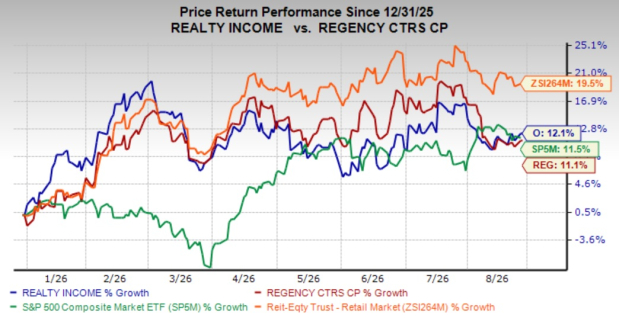
Image Source: Zacks Investment Research
O is trading at a forward 12-month price-to-FFO — a commonly used multiple for valuing REITs — of 13.89X, which is above its three-year median of 13.24X.
Meanwhile, REG is presently trading at a forward 12-month price-to-FFO of 15.31X, which is slightly below its three-year median of 15.34X. Both O and REG carry a Value Score of D.
While Realty Income looks cheaper, the gap suggests investors are paying a modest premium for Regency’s stronger internal growth and development platform. The premium is not extreme, but it means REG needs to execute well. On this measure alone, O has the valuation advantage.

Image Source: Zacks Investment Research
Conclusion: REG Has the Edge
Realty Income remains a dependable REIT with exceptional scale, broad diversification, strong liquidity and a dividend record that few peers can match. Those qualities make it reasonable for existing shareholders to stay with the name, especially when income stability is the main goal.
Regency, however, has an attractive mix of property-level growth, leasing leverage and development-driven expansion. Its focused grocery-anchored portfolio is benefiting from limited supply and healthy tenant demand, while the development pipeline adds another route to earnings growth. For investors choosing between the two now, REG offers the stronger combination of operating momentum and growth potential.
While O has a Zacks Rank #3 (Hold), REG carries a Zacks Rank #2 (Buy). You can see the complete list of today’s Zacks #1 Rank (Strong Buy) stocks here.
Note: Anything related to earnings presented in this write-up represent funds from operations (FFO) — a widely used metric to gauge the performance of REITs.
Radical New Technology Could Hand Investors Huge Gains
Quantum Computing is the next technological revolution, and it could be even more advanced than AI.
While some believed the technology was years away, it is already present and moving fast. Large hyperscalers, such as Microsoft, Google, Amazon, Oracle, and even Meta and Tesla, are scrambling to integrate quantum computing into their infrastructure.
Senior Stock Strategist Kevin Cook reveals 7 carefully selected stocks poised to dominate the quantum computing landscape in his report, Beyond AI: The Quantum Leap in Computing Power.
Kevin was among the early experts who recognized NVIDIA's enormous potential back in 2016. Now, he has keyed in on what could be "the next big thing" in quantum computing supremacy. Today, you have a rare chance to position your portfolio at the forefront of this opportunity.
See Top Quantum Stocks Now >>Want the latest recommendations from Zacks Investment Research? Today, you can download 7 Best Stocks for the Next 30 Days. Click to get this free report
Regency Centers Corporation (REG): Free Stock Analysis Report
Realty Income Corporation (O): Free Stock Analysis ReportThis article originally published on Zacks Investment Research (zacks.com).
Zacks Investment Research