Pharma/biotech giants Pfizer PFE and Bristol Myers BMY boast a dominant position in the lucrative oncology space.
Oncology remains one of the most attractive and competitive areas in the pharma and biotech industry. With cancer cases continuing to rise worldwide, demand for innovative treatments is expected to drive sustained growth in the global oncology market.
Pfizer is one of the largest and most successful drugmakers in the field of oncology. Oncology sales comprise around 27% of its total revenues.
Oncology is a key therapeutic area of focus for Bristol Myers, which is developing and delivering transformational drugs in this space.
Both Pfizer and Bristol Myers maintain strong positions in their core therapeutic markets and have historically generated solid shareholder returns. Evaluating their fundamentals, growth drivers, pipeline strength, potential risks and valuation levels can help investors determine which stock currently offers the more compelling investment opportunity.
The Case for Pfizer
Pfizer has built an innovative oncology product portfolio focused on targeting cancer through multiple modalities, including small molecules, antibody-drug conjugates (ADCs), multispecific antibodies and other immuno-oncology biologics. These therapies address a wide range of cancers, such as breast, genitourinary, hematologic, melanoma, gastrointestinal, gynecological and lung cancers.
Approved drugs in the portfolio include Ibrance, Xtandi, Padcev, Lorbrena, Adcetris, Inlyta, Braftovi/Mektovi, Bosulif, Tukysa, Elrexfio and Talzenna, among others. The breast cancer drug Ibrance is one of the top revenue generators in Pfizer’s oncology franchise.
The acquisition of Seagen in December 2023 strengthened PFE’s oncology portfolio by adding four ADCs — Adcetris, Padcev, Tukysa and Tivdak. The incremental sales from Seagen boosted oncology sales for the company. Seagen also has some next-generation ADC candidates in its pipeline and their successful development should further strengthen its portfolio.
PFE is pursuing label expansions for several of its cancer drugs, which could help boost sales.
Pfizer had earlier inked a licensing agreement with 3SBio for the development, manufacturing and commercialization of SSGJ-707, a bispecific antibody targeting PD-1 and VEGF, outside China.
PFE has oncology biosimilars in its portfolio and markets six of them for cancer. Oncology biosimilars primarily include Retacrit, Ruxience, Zirabev, Trazimera and Nivestym. Its oncology biosimilars generated $768 million in sales in the first half of 2026, up 24% year over year.
Pfizer is also advancing a robust pipeline of oncology candidates across areas such as breast, thoracic, genitourinary and blood cancer.
By 2030, it expects to have eight or more blockbuster oncology drugs in its portfolio.
Apart from oncology, Pfizer’s portfolio has a variety of drugs and vaccines for diseases like COVID-19, inflammation & immunology diseases, rare diseases and migraine, among others.
The Case for Bristol Myers
BMY is focused on extending and strengthening its leadership in immuno-oncology (IO), as well as diversifying beyond IO. Blockbuster IO drug Opdivo, approved for several cancer indications, drives its oncology franchise along with Yervoy and Opdualag.
The FDA approval of Opdivo Qvantig (nivolumab and hyaluronidase-nvhy) injection for subcutaneous use has boosted its IO franchise. Per BMY, this new subcutaneous formulation of Opdivo should help extend the reach and impact of its IO franchise to patients into the next decade.
BMY has been active on the acquisition front to expand its oncology portfolio/pipeline. In 2024, BMY acquired Mirati, a commercial-stage targeted oncology company, obtaining the rights to commercialize lung cancer medicine Krazati and further develop several clinical assets, including a PRMT5 inhibitor.
Krazati, a KRAS inhibitor, is approved for second-line non-small cell lung cancer (NSCLC) and is in clinical development with a PD-1 inhibitor for first-line NSCLC. It is also FDA-approved for advanced or metastatic KRAS-mutated colorectal cancer with cetuximab.
The acquisition of RayzeBio added radiopharmaceutical therapeutics, one of the fastest-growing new modalities for treating patients with solid tumors, to BMY’s pipeline.
In 2022, BMY acquired Turning Point and added lead asset, repotrectinib, and other clinical and pre-clinical stage assets to its pipeline. Repotrectinib was approved by the FDA in November 2023 and is marketed under the brand name Augtyro.
Augtyro, a kinase inhibitor, is indicated for the treatment of adult patients with locally advanced or metastatic ROS1-positive NSCLC. It is also intended for the treatment of adult and pediatric patients 12 years of age and older with solid tumors that have NTRK gene fusion, are locally advanced or metastatic or where surgical resection is likely to result in severe morbidity, and have progressed following treatment or have no satisfactory alternative therapy.
The company has also collaborated with BioNTech for the global co-development and co-commercialization of the latter’s investigational bispecific antibody pumitamig for numerous solid tumor types.
Bristol Myers is also focused on developing drugs with presence in hematology, immunology, cardiovascular, neuroscience and other therapeutic areas.
A Look at Estimates: PFE vs BMY
The Zacks Consensus Estimate for PFE’s 2026 sales implies a year-over-year decrease of 0.24%, and that for earnings per share (EPS) suggests a decline of 7.45%. EPS estimates for 2026 have moved south in the past 60 days while those for 2027 have moved north.
PFE’s Estimate Movement

Image Source: Zacks Investment Research
The Zacks Consensus Estimate for BMY’s 2026 sales implies a year-over-year increase of 3.38% while that EPS suggests an increase of 11.54%. EPS estimates for 2026 have increased to $6.86 from $6.32 in the past 60 days, while that for 2027 has increased to $6.44 from $6.05 in the same time frame.
BMY’s Estimate Movement

Image Source: Zacks Investment Research
Price Performance and Valuation of PFE and BMY
From a price-performance perspective, BMY has fetched better year-to-date returns than PFE. Shares of BMY have gained 24.7%, while those of PFE have risen 12.3%. The large-cap pharma industry has gained 18.2% in the said period.

Image Source: Zacks Investment Research
From a valuation standpoint, we use the P/E ratio of the large-cap pharma industry to compare these companies. Going by the same, BMY is slightly more expensive than PFE. BMY’s shares currently trade at 10.22X forward earnings, higher than 9.49X for BMY.
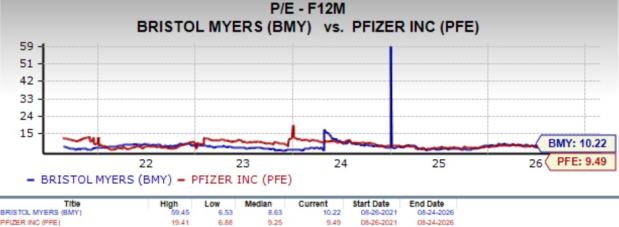
Image Source: Zacks Investment Research
PFE and BMY’s attractive dividend yield is a strong positive for investors. However, PFE’s dividend yield of 6.13% is higher than BMY’s 3.76%.
Which Stock Is a Better Pick for Now?
Large pharma/biotech companies are generally considered safe havens for investors interested in this sector.
Since both PFE and BMY stocks currently carry a Zacks Rank #3 (Hold), choosing one over the other could be tricky. You can see the complete list of today’s Zacks #1 Rank (Strong Buy) stocks here.
PFE boasts a strong and diversified portfolio. Key products such as Vyndaqel, Padcev and Eliquis, along with new launches and recently acquired assets, should help cushion the impact of patent expirations affecting several key drugs.
BMY’s efforts to revive its top line amid generic pressure on legacy products are also encouraging. Growth from newer drugs should help offset continued erosion from generic competition, while recent collaborations and acquisitions are adding further strength to its pipeline.
However, we believe PFE is the more attractive pick at present, supported by its compelling valuation and broader, more diversified portfolio.
Radical New Technology Could Hand Investors Huge Gains
Quantum Computing is the next technological revolution, and it could be even more advanced than AI.
While some believed the technology was years away, it is already present and moving fast. Large hyperscalers, such as Microsoft, Google, Amazon, Oracle, and even Meta and Tesla, are scrambling to integrate quantum computing into their infrastructure.
Senior Stock Strategist Kevin Cook reveals 7 carefully selected stocks poised to dominate the quantum computing landscape in his report, Beyond AI: The Quantum Leap in Computing Power.
Kevin was among the early experts who recognized NVIDIA's enormous potential back in 2016. Now, he has keyed in on what could be "the next big thing" in quantum computing supremacy. Today, you have a rare chance to position your portfolio at the forefront of this opportunity.
See Top Quantum Stocks Now >>Want the latest recommendations from Zacks Investment Research? Today, you can download 7 Best Stocks for the Next 30 Days. Click to get this free report
Bristol Myers Squibb Company (BMY): Free Stock Analysis Report
Pfizer Inc. (PFE): Free Stock Analysis ReportThis article originally published on Zacks Investment Research (zacks.com).
Zacks Investment Research