SoFi Technologies SOFI is increasingly moving beyond its roots as an online lender toward becoming a broad digital financial-services platform. The company’s strategy rests on attracting members through products such as checking and savings, investing and financial planning, and then encouraging them to use additional services across the platform. As that ecosystem expands, the opportunity to increase customer engagement and lifetime value also grows.
This approach differentiates SoFi from fintech peers with more concentrated business models. Upstart Holdings UPST remains more closely tied to AI-driven lending, while Affirm Holdings AFRM is primarily associated with buy-now-pay-later financing. In contrast, SoFi combines banking, investing, lending, payments and financial technology infrastructure under one umbrella.
Yet SOFI stock has struggled in 2026, declining sharply despite continued business expansion. Its performance has been broadly weak alongside Upstart Holdings, while Affirm Holdings has held up comparatively better. This disconnect between operating progress and share price performance makes SoFi’s improving product flywheel particularly important to the investment debate.
Year-to-date Stock Price Performance

Image Source: Zacks Investment Research
Cross-Buy Is Becoming Central to SoFi’s Growth Story
The strongest part of SoFi’s strategy is no longer simply adding new members. The more important development is that existing customers are increasingly adopting additional products.
SoFi’s model starts with products that can attract users frequently and at relatively low acquisition costs, such as SoFi Money, Relay and Invest. Once customers enter the ecosystem, the company can introduce lending, credit cards, investing services and other offerings without having to spend as much to acquire that customer again.
Recent trends support this strategy. In the second quarter, 51% of new products were opened by existing members compared with 35% a year earlier. Management also said products per member have accelerated over the past two quarters, suggesting that the benefits of its “everything app” strategy are becoming more visible.
This matters because higher cross-buy can improve economics in several ways. It raises revenue per customer, spreads acquisition costs across more products and creates opportunities to build longer relationships. This gives SoFi a potential advantage over Upstart Holdings, where revenues remain more dependent on credit origination activity, and Affirm Holdings, whose growth is closely connected with merchant volumes and consumer financing demand.
SOFI’s New Products Are Giving Flywheel More Fuel
SoFi is also widening the number of ways members can interact with its platform. The relaunched SoFi Plus subscription is one example. More than 200,000 members had adopted the paid offering after one quarter, with most coming from SoFi’s existing customer base. A portion of those subscribers subsequently opened another SoFi product.
SoFi Coach represents another effort to deepen engagement by using customer financial data to provide personalized guidance. Meanwhile, the Invest platform continues to expand through new investment tools and broader asset access. Its August-announced private-market offerings from CAZ Investments and AngelList Asset Management add another dimension to the investing business and could help SoFi capture more customer assets over time.
These products are important because 87% of SoFi’s total products are now non-lending offerings. Such products tend to be used more frequently and generally carry lower acquisition costs than lending products, helping bring users into the ecosystem before they potentially adopt higher-value services later.
Diversification Could Make Earnings More Durable for SOFI
Another encouraging part of the story is SoFi’s attempt to reduce its dependence on traditional balance sheet lending. The Loan Platform Business allows the company to originate loans for partners and earn fee income without retaining all of the credit exposure.
SoFi is extending that model beyond personal loans into small-business lending and home-equity products. Management believes this can increase capital-light fee revenues while also bringing more members into the broader ecosystem.
At the same time, Financial Services and Technology Solutions are intended to become a larger portion of the revenue mix. This could gradually make SoFi less sensitive to lending cycles and funding conditions. Relative to Upstart Holdings and Affirm Holdings, SoFi offers a broader mix of revenue opportunities, although that diversification makes execution more complex.
Quarterly performance provides evidence that the strategy is progressing. Adjusted net revenues increased 40% year over year in the latest quarter, while adjusted EBITDA rose 44%. The more relevant takeaway is that SoFi is generating enough profitability to keep investing in new products without abandoning earnings discipline.
SOFI’s Estimate Revisions Depict an Improving Outlook
Over the past 60 days, estimates for SOFI’s 2026 and 2027 EPS have been revised marginally upward. The consensus mark for 2026 and 2027 EPS suggests a year-over-year increase of 53.85% and 34.86%, respectively.
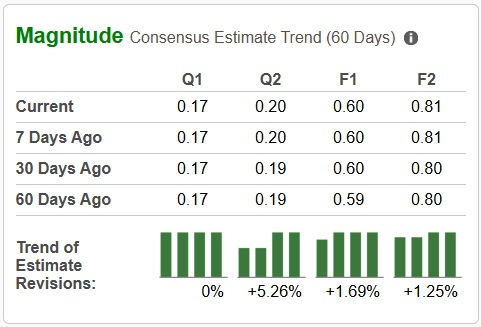
Image Source: Zacks Investment Research
Valuation Keeps Expectations Elevated
SOFI trades at 4.24X forward 12-month price-to-sales versus 4.67X for AFRM and 1.65X for UPST.
The key issue is that investors already assign significant value to SoFi’s growth potential. Its valuation remains above UPST’s and closer to AFRM’s, meaning continued member growth, stronger cross-buy and improving margins are necessary to support the premium.
There are also execution risks. Technology Solutions still needs to become a stronger growth contributor, lending remains exposed to credit conditions, and rapid product expansion requires sustained investment. If cross-buy slows or customer acquisition costs rise, the economics of the flywheel could become less attractive.
Valuation

Image Source: Zacks Investment Research
What Should Investors Do With SOFI Now?
SoFi’s investment case is becoming more balanced as its product ecosystem begins to generate stronger cross-buy and deeper customer engagement. The combination of banking, investing, lending and newer subscription and advisory products gives it more growth paths than UPST and a broader financial-services model than AFRM. Greater fee-based revenues could also make earnings more durable over time.
Still, the current valuation assumes that much of this progress will continue, while execution and credit risks remain. Existing investors may consider retaining their exposure, while prospective investors could wait for a more attractive entry point or further evidence that the flywheel can sustain its pace.
At present, SOFI carries a Zacks Rank #3 (Hold). You can see the complete list of today’s Zacks #1 Rank (Strong Buy) stocks here.
Zacks' Research Chief Names "Stock Most Likely to Double"
Our team of experts has just released the 5 stocks with the greatest probability of gaining +100% or more in the coming months. Of those 5, Director of Research Sheraz Mian highlights the one stock set to climb highest.
This top pick is a little-known satellite-based communications firm. Space is projected to become a trillion dollar industry, and this company's customer base is growing fast. Analysts have forecasted a major revenue breakout in 2025. Of course, all our elite picks aren't winners but this one could far surpass earlier Zacks' Stocks Set to Double like Hims & Hers Health, which shot up +209%.
Free: See Our Top Stock And 4 Runners UpWant the latest recommendations from Zacks Investment Research? Today, you can download 7 Best Stocks for the Next 30 Days. Click to get this free report
SoFi Technologies, Inc. (SOFI): Free Stock Analysis Report
Upstart Holdings, Inc. (UPST): Free Stock Analysis Report
Affirm Holdings, Inc. (AFRM): Free Stock Analysis ReportThis article originally published on Zacks Investment Research (zacks.com).
Zacks Investment Research