Palantir Technologies (PLTR), Micron Technology (MU) and Space Exploration Technologies Corp. (SPCX) represent three of the most compelling companies in the market today, each sitting at the center of some of the world’s most important investment themes. They also generate unusually wide disagreement among investors, attracting both exuberant bulls and deeply skeptical bears.
Palantir and SpaceX are two of the most richly valued large-cap companies in the market. Both are led by outspoken, contrarian founders, operate businesses that are difficult to fit neatly into traditional frameworks and face few direct competitors at comparable scale. At the same time, both are growing exceptionally fast and are exposed to enormous secular tailwinds across artificial intelligence, space, defense, data infrastructure and government spending.
Micron presents a different, but similarly difficult, valuation question. The company has emerged as one of the most critical beneficiaries of the AI data center buildout, particularly through the explosive demand for advanced memory. That investment case was much easier to make a year ago. Following a nearly 10x increase in the stock, however, determining how much upside remains has become considerably more complicated.
I will break down each company in greater detail below, but the short version is this: Palantir stands out as the most compelling buy, followed by SpaceX, as both continue to show exceptional business momentum and favorable price action. Micron looks more like a hold. The company should continue to perform well, but I believe the memory cycle is much closer to maturity, while capital within the AI boom is likely to migrate toward the next supply-constrained corners of the ecosystem.
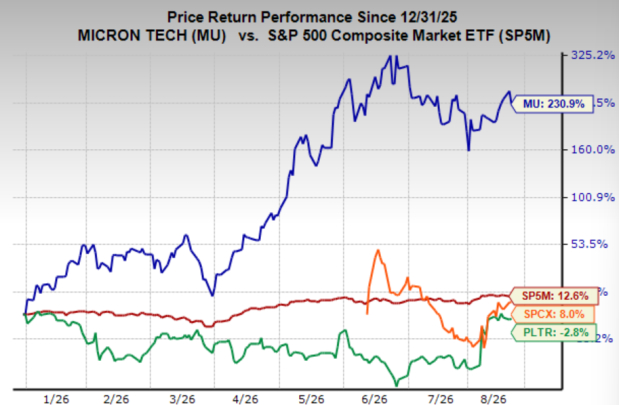
Image Source: Zacks Investment Research
Palantir Technologies: The Emerging AI Juggernaut
Palantir Technologies reported earnings a couple of weeks ago, and the results were outstanding. Revenue surged 93% year over year, while earnings jumped 225%, reinforcing the company’s position as one of the fastest-growing large-cap companies.
CEO Alex Karp has also begun drawing a sharper distinction between Palantir and the major AI labs, framing the company’s technology as a sovereign AI solution for corporate America and the government. His argument is that institutions need to capture the benefits of AI without sacrificing control of their data, intellectual property or business models.
Karp has repeatedly criticized the large AI labs for effectively turning the information users and businesses provide them into training data, warning that valuable intellectual property could be handed over on a silver platter. It is certainly a reasonable concern, and also a convenient one for Palantir’s business model.
More importantly, customers appear to be responding. Net dollar retention reached 157% in the most recent quarter, showing that existing customers are dramatically expanding their spending as Palantir moves beyond Foundry and deeper into its AI offerings. This will be one of the most important metrics to watch going forward, as it provides a falsifiable test of whether demand for more private, sovereign AI is translating into sustained spending.
Today, Palantir carries a Zacks Rank #2 (Buy), with earnings estimates rising roughly 7% across the board. Meanwhile, the stock trades near 80x next year’s earnings—undeniably expensive, but well below the multiples it has commanded through much of its history as a public company. With the share price going essentially nowhere over the past year while revenue and earnings have continued to compound rapidly, the valuation has compressed considerably.
The technical setup is compelling as well. PLTR recently broke out from a massive year-long bullish wedge following earnings. A brief period of consolidation would not be surprising, but the setup increasingly favors another leg higher and a move toward new record highs.
Among these three names, Palantir stands out as the most compelling opportunity. The valuation remains rich, but the combination of extraordinary growth, expanding profitability, rising earnings estimates and a stock that has spent the past year consolidating is difficult to ignore. Palantir increasingly looks like it is becoming a core AI layer across corporations and government, and the stock may begin to reflect this new narrative.

Image Source: TradingView
SpaceX: Hyperscaler Acceleration Plus Rockets and Satellites
Going into the IPO, I was skeptical of SpaceX, and I am glad I stayed away through the initial boom and bust. Following the company’s recent earnings report, however, my view has changed. The valuation remains demanding, but the combination of accelerating growth, powerful thematic exposure and renewed investor enthusiasm makes the stock increasingly compelling.
The latest earnings report was the catalyst. Revenue surged 92% year over year, net losses narrowed sharply and EBITDA jumped 191%. Starlink, the company’s primary cash-generating engine, continued to expand rapidly, with revenue up 66%, operating income rising 79% and subscriptions roughly doubling. The launch business also contributed solidly, growing 29% year over year.
The most interesting development, however, came from AI and cloud. Revenue from the segment surged 248% to $2.56 billion, and Musk is leaning aggressively into the opportunity, projecting nearly $50 billion in capital spending and targeting $100 billion in annual revenue by year-end. SpaceX also enters this expansion from a position of considerable financial strength, with roughly $100 billion in cash and marketable securities.
That shift matters because the AI narrative appears to be strengthening again following the recent semiconductor correction, and I increasingly suspect the hyperscalers could lead the next phase of the trade. Amazon, Microsoft and Meta have already demonstrated that massive AI investments can coexist with accelerating revenue and expanding margins. SpaceX is now positioning itself alongside that group.
For much of the past year, the central question surrounding AI spending has been simple: where is the return on all this capex? This earnings season provided considerably more evidence that the hyperscalers are beginning to generate it, while computing capacity remains constrained. If that trend continues, SpaceX’s combination of data centers, connectivity, launch infrastructure and enormous capital resources could place it near the center of the next major phase of AI investment.
The technical picture is encouraging as well. After correcting sharply from its IPO highs, the stock spent several months building a substantial base. Shares have since broken out decisively and are now forming what looks like a bull-flag consolidation. I would watch those consolidation levels closely for another potential continuation move.
SpaceX looks attractive following the selloff. The valuation is still rich, but business momentum is accelerating and the company has now added another major growth narrative through its data center ambitions. The shareholder base is also unusually enthusiastic, which can provide meaningful support when operating momentum is moving in the right direction.
Share unlocks remain a legitimate risk, but the early evidence has been encouraging. The tradable float more than doubled, from roughly 639 million shares to 1.55 billion, yet the stock still gained about 11% over two days. For now, the market appears more interested in the improving fundamental story than the additional supply.

Image Source: TradingView
Micron Technologies: AI Winner May See Moderating Stock Performance
Micron has undergone one of the most remarkable ascents in the technology sector in recent years. It has been extraordinary to watch not only the stock’s rise, but the acceleration in the underlying business as well. In the most recent quarter, earnings surged 693% year over year while revenue jumped 346%, as booming demand and sharply higher pricing for advanced memory briefly made Micron one of the most critical suppliers in the entire AI infrastructure buildout.
That kind of growth is highly unusual for a company of Micron’s scale, and the stock’s enormous appreciation over the past year has reflected it. The fundamental outlook remains strong, but Micron is still operating in a deeply cyclical industry. More importantly, the AI boom has repeatedly rotated from one supply-constrained component to the next. Memory has been the most recent major beneficiary, and I suspect the largest phase of that trade is now behind us.
That does not mean Micron is headed for a major decline. Rather, I expect the stock to transition from a major relative leader toward something closer to market performance, whether measured against the semiconductor group or the Nasdaq.
Nvidia offers a useful comparison. Its explosive gains in 2023 and 2024 marked the most dramatic phase of the trade. The stock has continued to perform well since then, but the magnitude of the gains has moderated considerably. Something similar may now be in store for Micron: continued fundamental strength and potentially solid absolute returns, but without the extraordinary outperformance of the past year.
The technical picture supports that view. After its enormous advance, MU appears likely to spend some time working through a broad consolidation, with choppier and more sideways price action as fundamentals catch up with the stock.
Valuation also deserves some caution. At roughly 13x forward earnings, Micron looks exceptionally cheap on the surface. But cyclical companies often appear cheapest near the strongest part of the earnings cycle, when profits and estimates are elevated. This may ultimately prove to be a longer-lasting AI-driven supercycle, so that does not imply an imminent collapse in earnings or the stock. It does, however, make the headline multiple less compelling than it first appears.
Still, the cyclical nature of the memory business will eventually come to roost, even if that point remains some distance away. I do not expect memory pricing or demand to remain this strong indefinitely. Eventually, supply will catch up, pricing will normalize and growth rates will moderate. The difficult question is not whether that happens, but when. For now, AI demand may extend the cycle considerably longer than historical precedent would suggest, but investors should be careful not to extrapolate today’s extraordinary conditions indefinitely.
Micron is therefore the hardest of these three stocks for me to make a strong bullish case for today. The business remains excellent and AI demand remains powerful, but memory has already enjoyed its turn as the market’s critical supply constraint. I expect capital and investor attention to increasingly seek out the next bottleneck in the data center buildout. Micron can still perform well, but the extraordinary phase of its run is likely behind it, making the stock a hold rather than a buy at current levels.

Image Source: TradingView
Should Investors Buy, Hold or Sell Shares of SPCX, PLTR and MU?
All three companies remain major beneficiaries of powerful secular trends, but the investment setups are very different today.
Palantir is my favorite of the three, with exceptional growth, improving profitability and a technical breakout that could mark the beginning of its next major move. SpaceX is also attractive, particularly as its rapidly growing AI and cloud ambitions add another dimension to an already unique collection of businesses, though its valuation leaves less room for error.
Micron remains a hold. The company is executing exceptionally well, but memory has already experienced an extraordinary cycle of demand, pricing and investor enthusiasm. Those conditions can persist longer than expected, but they will not last forever.
The broader lesson is that leadership within the AI boom continues to rotate. Rather than chasing yesterday’s biggest winner, investors may be better served looking for where the next wave of growth, scarcity and capital is beginning to emerge.
Radical New Technology Could Hand Investors Huge Gains
Quantum Computing is the next technological revolution, and it could be even more advanced than AI.
While some believed the technology was years away, it is already present and moving fast. Large hyperscalers, such as Microsoft, Google, Amazon, Oracle, and even Meta and Tesla, are scrambling to integrate quantum computing into their infrastructure.
Senior Stock Strategist Kevin Cook reveals 7 carefully selected stocks poised to dominate the quantum computing landscape in his report, Beyond AI: The Quantum Leap in Computing Power.
Kevin was among the early experts who recognized NVIDIA's enormous potential back in 2016. Now, he has keyed in on what could be "the next big thing" in quantum computing supremacy. Today, you have a rare chance to position your portfolio at the forefront of this opportunity.
See Top Quantum Stocks Now >>Want the latest recommendations from Zacks Investment Research? Today, you can download 7 Best Stocks for the Next 30 Days. Click to get this free report
Micron Technology, Inc. (MU): Free Stock Analysis Report
Palantir Technologies Inc. (PLTR): Free Stock Analysis Report
Space Exploration Technologies Corp. (SPCX): Free Stock Analysis ReportThis article originally published on Zacks Investment Research (zacks.com).
Zacks Investment Research